









Pronunciation: ah-GOO-ja-SEH-ruh-tops
Meaning: Aguja horned face
Author/s: Lucas, Sullivan, Hunt (2006)
Synonyms: Chasmosaurus mariscalensis
First Discovery: Texas, USA
Acta Ordinal: #593
Agujaceratops mariscalensis
Discovered at three localities and five different-aged digsites within Big Bend National Park by William Strain way back in 1938, the material that would eventually become Agujaceratops wasn't properly scrutinized until 1989. With some of the associated remains cast aside Thomas Lehman hypothesized that what was left belonged to a transitional form somewhere between the Southern chasmosaurine Pentaceratops sternbergii and the Northern chasmosaurine Chasmosaurus, and although adamant that its affinities lay closer to the former he went ahead and placed it alongside the latter as a second species; Chasmosaurus mariscalensis.
The discovery of an almost complete skull (TMM 43098) southwest of Rattlesnake Mountain at Windy City during a Paul Sereno-led Big Bend expedition two years later confirmed Lehman's theory that it was a distinct species sporting features of both Chasmosaurus and Pentaceratops. But these similarities pale in comparison to its unique features, and a restudy of all "Chasmosaurus mariscalensis" remains in 2006 led Lucas, Sullivan and Hunt to the realisation that it was more distinct than either Lehman or Sereno's party had thought. Thus Agujaceratops was coined.
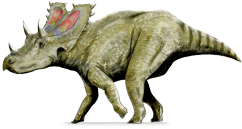
Agujaceratops has a shorter, broader face and relatively longer brow horns than Chasmosaurus and compared to Pentaceratops it's smaller in overall size with a shorter, wider frill and straighter, near-vertically oriented brow horns. Funnily enough, the Sereno-found skull that rekindled interest in this Big Bend ceratopsian may not be a specimen of Agujaceratops at all, and there are growing mumbles that it actually hails from the younger Javalina Formation and may belong to Bravoceratops polyphemus instead.
The discovery of an almost complete skull (TMM 43098) southwest of Rattlesnake Mountain at Windy City during a Paul Sereno-led Big Bend expedition two years later confirmed Lehman's theory that it was a distinct species sporting features of both Chasmosaurus and Pentaceratops. But these similarities pale in comparison to its unique features, and a restudy of all "Chasmosaurus mariscalensis" remains in 2006 led Lucas, Sullivan and Hunt to the realisation that it was more distinct than either Lehman or Sereno's party had thought. Thus Agujaceratops was coined.
Agujaceratops has a shorter, broader face and relatively longer brow horns than Chasmosaurus and compared to Pentaceratops it's smaller in overall size with a shorter, wider frill and straighter, near-vertically oriented brow horns. Funnily enough, the Sereno-found skull that rekindled interest in this Big Bend ceratopsian may not be a specimen of Agujaceratops at all, and there are growing mumbles that it actually hails from the younger Javalina Formation and may belong to Bravoceratops polyphemus instead.
(Aguja horn face from Mariscal)Etymology
Agujaceratops is derived from "Aguja" (for the Aguja Formation where it was found), and the Greek "keras" (horn) and "ops" (face).
The species epithet, mariscalensis, is derived from "Mariscal" (for Mariscal Mountain, seventeen miles southwest of Boquillas in Big Bend National Park) and the Latin "ensis" (from).
ZooBank registry: urn:lsid:zoobank.org:act:F5EEA7A7-34E4-482A-B04A-F5BA46A78D87.
Discovery


