








Pronunciation: AHR-kay-oh-SEH-ruh-tops
Meaning: Ancient horn face
Author/s: Dong and Azuma (1997)
Synonyms: None known
First Discovery: Gansu, China
Acta Ordinal: #425
Archaeoceratops oshimai
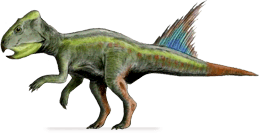
In a rather contradictory manner—arkhaios means "ancient" but neo means "new"—Archaeoceratops is one of the oldest neoceratopsians. It's also one of the smallest ceratopsians—a name derived from the Greek ceras "horn" and ops "face"—with many features found in its later-living, gigantic, horn-faced relatives. But, funnily enough, a horned face isn't one of them.
Despite its lack of ornamentation, Archaeoceratops did carry the basic blueprint of the ceratopsian skull. Its head shows the early broad, triangular profile and small frill that would later expand dramatically in its descendants, and its sharp beak was already an efficient tool for cropping tough plants. Its body, however, was lightly built and agile, reflecting the small, quick, bipedal foragers that characterised the earliest stages of ceratopsian evolution, long before four-leg drive became obligatory in the horned tanks of the Late Cretaceous.
Despite its lack of ornamentation, Archaeoceratops did carry the basic blueprint of the ceratopsian skull. Its head shows the early broad, triangular profile and small frill that would later expand dramatically in its descendants, and its sharp beak was already an efficient tool for cropping tough plants. Its body, however, was lightly built and agile, reflecting the small, quick, bipedal foragers that characterised the earliest stages of ceratopsian evolution, long before four-leg drive became obligatory in the horned tanks of the Late Cretaceous.
Etymology
Archaeoceratops is derived from the Greek "arkhaios" (ancient), "ceras" (horn) and "ops" (face). The species epithet, oshimai, honours Mr. Oshima, the director of Chunichi-Shinbuan: the Japanese newspaper publisher who supported the expedition that found its remains.
ZooBank registry: urn:lsid:zoobank.org:act:237C0BB1-88B2-48A8-B786-FA87D77BBA44.
Discovery
The first fossils of Archaeoceratops were discovered in the Xinminbao Group, Gongpoquan Basin, Mazongshan Area, Gansu Province, China, during the Sino-Japanese Silk Road dinosaur expedition in 1992. The Holotype (IVPP V 11114) includes a well preserved, nearly complete skull, partial vertebral column, and partial pelvis. The paratype (IVPP V 11115) is a partial vertebral column, a nearly complete tail, a partial pelvis, fragmentary hind limb bones, and a complete foot, from a much smaller specimen.


