









Pronunciation: PROH-to-AY-vis
Meaning: First bird
Author/s: Chatterjee (1991)
Synonyms: None known
First Discovery: Texas, USA
Acta Ordinal: #371
Protoavis texensis
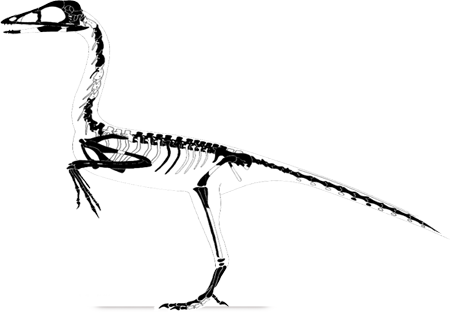
The problem with Protoavis, and it's quite a big one, is that its Triassic-aged bones don't seem to belong to a single critter or even a single species. A jumbled mess containing what appear to be coelurosaur bits, scraps reminiscent of drepanosaurids, and pieces that resemble various relatives of Coelophysis prompt cries of "chimera!" from almost all palaeontologists. Apart, that is, from Sankar Chatterjee, who refers to Protoavis as "the first bird" and champions its importance in understanding the origin and evolution of our flying feathered friends.
We can't help feeling that old Sankar is a little biased. Protoavis is his discovery, after all. But even Sterling Nesbitt, who is renowned for cleaning up messy taxa, would only commit to "non-tetanuran theropod in part" in his critical re-evaluation of Triassic dinosaurs, and point-blank refused to discuss some of its remains pending a thorough review. Presumably, he doesn't fancy that job himself, which tells its own story.
If Protoavis really is a bird, it would predate Urvogel—the German name for Archaeopteryx, which literally means "first bird"—by some 75 million years, and upend almost every timeline we have for the early evolution of dinosaurs and birds, and the anatomical experiments that bridge the two. A claim that extraordinary demands evidence far cleaner than a Triassic-age grab bag of bones from an old river delta, that were quite possibly swept together by a flash flood.
We can't help feeling that old Sankar is a little biased. Protoavis is his discovery, after all. But even Sterling Nesbitt, who is renowned for cleaning up messy taxa, would only commit to "non-tetanuran theropod in part" in his critical re-evaluation of Triassic dinosaurs, and point-blank refused to discuss some of its remains pending a thorough review. Presumably, he doesn't fancy that job himself, which tells its own story.
If Protoavis really is a bird, it would predate Urvogel—the German name for Archaeopteryx, which literally means "first bird"—by some 75 million years, and upend almost every timeline we have for the early evolution of dinosaurs and birds, and the anatomical experiments that bridge the two. A claim that extraordinary demands evidence far cleaner than a Triassic-age grab bag of bones from an old river delta, that were quite possibly swept together by a flash flood.
(First bird from Texas)Etymology
Protoavis is derived from Greek "protos" (first) and the Latin "avis" (bird). The species epithet, texensis, means "from Texas" in Latin.
Discovery
The first remains of Protoavis were discovered in the Bull Canyon Formation (formerly called the Cooper Member of the Dockum Formation, and later the Cooper Canyon Formation) at Post Quarry on Miller's Ranch, near the city of Post, Garza County, Texas, by Sankar Chaterjee in 1984.The holotype (TTUP 9200) is a partial skull and bits of skeleton. Referred material includes a paratype partial skull and skeleton of a smaller individual (TTUP 9201) from the Post Quarry, and various isolated elements (TTUP 9350–9380) from Kirkpatrick Quarry in the Tecovas: a Texas formation that has also yielded fossils of Chindesaurus and Tecovasaurus.


