









Pronunciation: ruh-PAY-too-SOR-us
Meaning: Mischievous giant lizard
Author/s: Curry Rogers & Forster (2001)
Synonyms: None known
First Discovery: Mahajanga, Madagascar
Acta Ordinal: #500
Rapetosaurus krausei
Although titanosaurs were the latest-living sauropods and thrived on every continent barring Antarctica right up to the mass extinction of species some 66 million years ago, the remains of many are mostly disappointing, oftentimes amounting to nothing more than the odd leg bone or vertebra.
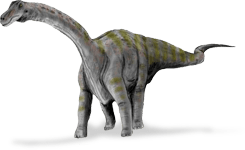
But the discovery of Rapetosaurus came as a breath of fresh air. It's known from an adult skull plus a juvenile specimen which is virtually complete from snout to tail-tip and the only titanosaur ever found with a head still attached to the body. The completeness of these specimens confirmed just how similar in bodily features to brachiosaurid sauropods titanosaurs actually were. However, the skull was unusual in that it wasn't brachisaurid-like at all, being low and long with pencil-shaped teeth, which is a design typical of another branch of sauropods known as diplodocids.
Tiny Giants
Titanosauria sports some of the largest land-dwelling critters in earth's history, but they weren't born that way. In 2016, Kristina Curry-Rogers studied the micro bone structure of a baby Rapetosaurus that was mingled with turtle and crocodile bones from Madagascar and concluded that it weighed a mere 3.5 kilos as it burst forth from its egg, but had grown in weight ten-fold and measured 35cm at the hip by the time it perished just two months later.
The study also showed that, unlike theropod and ornithischian juveniles who spent a large portion of their early life nest-bound and reliant on their parents for food, Rapetosaurus youngsters were precocious. Proportionately, they were the same shape as the adults, suggesting they were able to walk and do their own thing pretty much from hatchlings, though not necessarily successfully; plates of preserved cartilage between the bones of this particular individual were extremely thin, which is consistent with a critter that has starved to death.
(Krause's mischievous giant lizard)Etymology
Rapetosaurus is derived from "Rapeto" (a mischievous, mythical giant in Malagasy folklore) and the Greek "sauros" (lizard).
The species epithet, krausei (KROW-sie), honors
David Krause—team leader of the joint State University of New York and Universite d'Antananarivo digging gang who discovered the specimen.
Discovery
The remains of Rapetosaurus were discovered in the Anembalemba Member of the Maevarano Formation, Mahajanga basin, north west Madagascar, a stones-throw from the port city of Mahajanga, in 1995.
The holotype (UA 8698, housed at Universite d'Antananarivo) is an almost complete adult skull.


