









Pronunciation: a-RAW-ruh-SEH-ruh-tops
Meaning: Early horned face
Author/s: You, Li, Dodson, et al. (2005)
Synonyms: None known
First Discovery: Gansu, China
Acta Ordinal: #590
Auroraceratops rugosus
Discovered at Mazong Shan seven years after Archaeoceratops—which is a slightly smaller critter of the same stamp, Auroraceratops is named for its status as an early neoceratopsian and also to honour the wife of one of its describing authors. Both the Latin "aurora" and Peter Dodson's better half are "dawn", but please note; the latter is honoured in recognition of being a most gracious hostess to several generations of palaeontologists rather than bearing any resemblance, features wise, which is probably just as well.
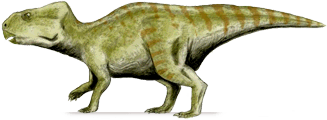
Unlike other neoceratopsians who typically have a long, narrow snout, Auroraceratops has a shorter wider one with two pairs of ridged, fang-like teeth at the front, and it's attached to a rather flat and exceptionally broad skull. Its face is a bit, well, lumpy, due to raised areas around the eyes, on the cheeks and on the lower jaw, and as these areas are rough in texture, chances are they anchored a keratin coating in life, which would only increase their lumpiness.
Auroraceratops rugosus is one of two genera and four species of non-coronosaurian neoceratopsians known from the Mazongshan area, but it is the least understood, because a skull represents the entirety of its confirmed remains. That said, a virtually complete skeleton that was heralded as South Korea's first known ceratopsian—found near the entrance to Dudo's Gamcheon Port in 2010—perhaps belongs to Auroraceratops, which could shed some much-needed light on this most enigmatic creature. However, that specimen has yet to be described and may turn out to be an Archaeoceratops, but it isn't the specimen from Tando Dam which was also reported as South Korea's first known ceratopsian, because that one was described by Yuong-Nam Lee and christened Koreaceratops in 2011.
Unlike other neoceratopsians who typically have a long, narrow snout, Auroraceratops has a shorter wider one with two pairs of ridged, fang-like teeth at the front, and it's attached to a rather flat and exceptionally broad skull. Its face is a bit, well, lumpy, due to raised areas around the eyes, on the cheeks and on the lower jaw, and as these areas are rough in texture, chances are they anchored a keratin coating in life, which would only increase their lumpiness.
Auroraceratops rugosus is one of two genera and four species of non-coronosaurian neoceratopsians known from the Mazongshan area, but it is the least understood, because a skull represents the entirety of its confirmed remains. That said, a virtually complete skeleton that was heralded as South Korea's first known ceratopsian—found near the entrance to Dudo's Gamcheon Port in 2010—perhaps belongs to Auroraceratops, which could shed some much-needed light on this most enigmatic creature. However, that specimen has yet to be described and may turn out to be an Archaeoceratops, but it isn't the specimen from Tando Dam which was also reported as South Korea's first known ceratopsian, because that one was described by Yuong-Nam Lee and christened Koreaceratops in 2011.
(Rough Dawn horn face)Etymology
Auroraceratops is derived from the Latin "aurora" (Dawn) and the Greek "keras" (horn) and "ops" (face), which refers to its status as an early
neoceratopsian and also honours Dawn Dodson, the wife of palaeontologist Peter Dodson.
The species epithet, rugosus, means "rough" in Latin, referring to the various rugose areas on the surface of its skull and jaws that may have been contact points during butting or shoving contests for mating rights.
Discovery
The first remains of Auroraceratops were discovered in an unnamed unit of the Xinminpu Group, Gongpoquan Basin, Mazongshan Area, Gansu Province, China, by Li Daqing of the Fossil Research and Development Center of the Third Geology and Mineral Resources Exploration Academy of Gansu Province.
The holotype (IG-2004-VD-001) is an almost complete sub-adult skull
(200mm long).


