









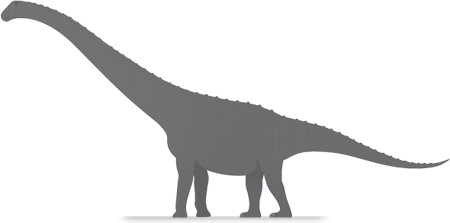
Pronunciation: bruh-ZIL-o-TIE-tuhn
Meaning: Brazil Giant
Author/s: Machado et al. (2013)
Synonyms: None known
First Discovery: São Paulo, Brazil
Acta Ordinal: #866
Brasilotitan nemophagus
Apart from a single diplodocoid (Amazonsaurus maranhensis), all officially named sauropods from Brazil as of 2013 were titanosaurs; eight in total, and all but two of them lack any material from the skull. Brasilotitan was number nine and included a squared lower jaw suggesting a "boxy" snout similar to both Antarctosaurus wichmannianus and Bonitasaura salgadoi, but with features previously unseen in those herbivorous, broad-chested, quadrupedal dinosaurs.
Not to be confused with Brazilosaurus (an aquatic mesosaur) or Brasileosaurus (a "dinosaur" named by von Huene in 1931 for a hotchpotch of barely identifiable fossils that turned out to be an extinct land-dwelling crocodile), Brasilotitan is a middle-of-the-road titanosaur, neither advanced nor derived, but rather small for one of a group of sauropods known as "giant lizards" at an estimated smidgen under twelve-metres in length.
Not to be confused with Brazilosaurus (an aquatic mesosaur) or Brasileosaurus (a "dinosaur" named by von Huene in 1931 for a hotchpotch of barely identifiable fossils that turned out to be an extinct land-dwelling crocodile), Brasilotitan is a middle-of-the-road titanosaur, neither advanced nor derived, but rather small for one of a group of sauropods known as "giant lizards" at an estimated smidgen under twelve-metres in length.
(Plant-eating Brazil giant)Etymology
Brasilotitan is derived from "Brazil" (its country of origin) and the Greek "titan" (giant).
The species epithet, nemophagus, is derived from the Greek "nemos" (pasture, wood) and "phagein" (to eat), in reference to its herbivorous nature.
Discovery
The first remains of Brasilotitan were stumbled upon by William R. Nava in roadside rubble during the widening of Raposo Tavares state road (Highway SP-270) in the suspected Adamantina Formation (Bauru Basin) near Presidente Prudente city, São Paulo State, Brazil, in 2000. More remains were spotted during several visits by Nava over the coming months, but they were either too large or awkwardly placed to remove at the time, and when he returned with reinforcements to collect them at the end of that year, they had all been pummelled and used as road support.
Owing to the nature of their discovery, Steve Brusatte reckons the markers used to date the strata may have been churned up from a lower layer and be misleading, and the bones of Brasilotitan might be from the younger Presidente Prudente Formation.
The holotype (MPM 125R, housed at the Museu de Paleontologia de Marília) includes a lower jaw, two neck vertebrae and fragmentary neck ribs, three hip vertebrae, two fragmentary pelvic bones, and a toe claw. A tooth fragment (MPM 126R) found nearby was referred to the same skeleton. One of the pelvic bones has conical punctures on its surface that Machado et al. interpreted as probable bite marks, suggesting the specimen was scavenged after death by either a theropod or a crocodile ancestor, both of which left teeth at the scene.


