




Pronunciation: eye-nee-o-SOR-us
Meaning: Buffalo lizard
Author/s: Sampson (1995)
Synonyms: None known
First Discovery: Montana, USA
Acta Ordinal: #413
Einiosaurus procurvicornis
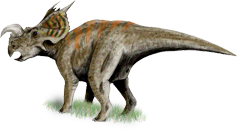
Einiosaurus had a huge nose horn but it curved forwards and down, a bit like the blade on an old-fashioned "stab and jack" can opener (ask your Mum!), which may have been a stepping stone in the evolution of older, straight nose-horned centrosaurines into the latest-living boss-nosed pachyrhinosaurs.
At least fifteen all-age-range specimens are thought to be amongst hundreds of bones discovered in beds at Montana's Two Medicine Formation - probably the victims of a flash flood or some similarly catastrophic naturally occurring disaster - and every one of them is currently being hogged by the Museum of the Rockies in Bozeman.
At least fifteen all-age-range specimens are thought to be amongst hundreds of bones discovered in beds at Montana's Two Medicine Formation - probably the victims of a flash flood or some similarly catastrophic naturally occurring disaster - and every one of them is currently being hogged by the Museum of the Rockies in Bozeman.
(Buffalo lizard with a forward pointing horn)Etymology
Einiosaurus is derived from the Black Foot word "eini" (buffalo), referring to the contention that ceratopsids were buffalo of the Cretaceous, and the Greek "sauros" (lizard). The Black Foot are a tribe of Native American Indians who own the land that this ceratopsian dinosaur was pulled from.
The species epithet, procurvicornis, is derived from the Latin "procurvus" (bent forwards) and cornu "horn".Before being named by Sampson in 1995, Einiosaurus was informally referred to as "Styracosaurus makeli" by field crew members, in honour of Horner's associate Bob Makela who had died in a traffic accident in June 1987.
In 2010, Greg Paul moved Einiosaurus procurvicornis to Centrosaurus as Centrosaurus procurvicornis, but no one took a blind bit of notice.
Discovery
The first fossils of Einiosaurus were discovered in the upper Two Medicine Formation at Canyon Bonebed (Landslide Butte field area) on the land of Gloria Sundquist, 42km northwest of Cut Bank, Glacier County, Montana, USA, by Jack Horner and Carrie Ancell in 1985.
The holotype (MOR 456-8-9-6-1) is a partial adult skull. Sampson referred multiple other specimens from Canyon bonebed, catalogued within MORE 456, to Einiosaurus, including two more adult skulls and assorted skull and skeletal elements from individuals of various ages. Around 200 bones from Dino Ridge Quarry, 2km from Canyon Bonebed, were also referred to Einiosaurus, catalogued under MOR 373. All bones were excavated between 1985-1989 by Museum of the Rockies field crews.
Preparators
Carrie Ancell of Museum of the Rockies in Bozeman, Montana.


