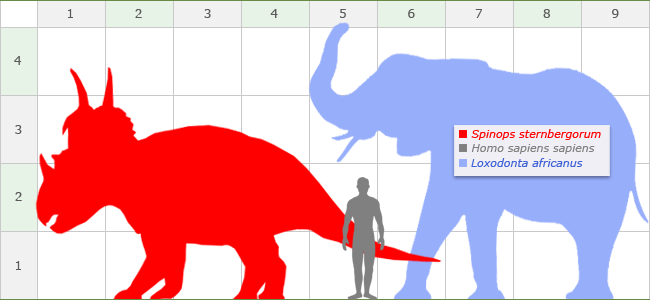
Pronunciation: SPIEN-ops
Meaning: Spine face
Author/s: Farke et al. (2011)
Synonyms: None known
First Discovery: Alberta, Canada
Acta Ordinal: #807
Spinops sternbergorum
As an early Christmas present to the good folks of dino-lovin' land in mid-December 2011, Andy Farke and chums named Spinops sternbergorum based on at least one partial skull which was discovered in England. Yes, England.
Okay, it wasn't unearthed in England. But it had spent the best part of a century there, gathering dust on a shelf at London's Natural History Museum having been deemed "rubbish" and no good for display. The Sternbergs had done the donkey work, hauling it out of Dinosaur Provincial Park in Alberta, Canada way back in 1916. But after sending it to the UK for study it wound up as just another number lost amongst copious amounts of as-yet undescribed fossils until it was stumbled upon in December 2011.
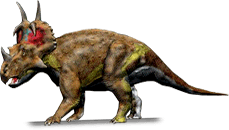
Spinops was a member of Centrosaurinae, a group of herbivorous dinosaurs within Ceratopsia ("horned faces"), many of which are renowned for their outrageously flamboyant head decor. Aside from its single large nose horn, Spinops had a bony neck frill sporting at least two long, backward-projecting spikes and two forward-curving hooks which, from an evolutionaty point of view, seems to plonk it somewhere between fellow centrosaurines Centrosaurus and the king of facial bling, Styracosaurus.
Okay, it wasn't unearthed in England. But it had spent the best part of a century there, gathering dust on a shelf at London's Natural History Museum having been deemed "rubbish" and no good for display. The Sternbergs had done the donkey work, hauling it out of Dinosaur Provincial Park in Alberta, Canada way back in 1916. But after sending it to the UK for study it wound up as just another number lost amongst copious amounts of as-yet undescribed fossils until it was stumbled upon in December 2011.
Spinops was a member of Centrosaurinae, a group of herbivorous dinosaurs within Ceratopsia ("horned faces"), many of which are renowned for their outrageously flamboyant head decor. Aside from its single large nose horn, Spinops had a bony neck frill sporting at least two long, backward-projecting spikes and two forward-curving hooks which, from an evolutionaty point of view, seems to plonk it somewhere between fellow centrosaurines Centrosaurus and the king of facial bling, Styracosaurus.
(Sternbergs Spine Face)
Etymology
Spinops is derived from the Latin "spina" (spine) and the Greek "-ops" (face).The species epithet, sternbergorum (stern-berg-OR-uhm) is named to honor the Sternbergs (see discovey).
Discovery
The remains of Spinops were discovered at Berry Creek in the Oldman Formation (Belly River Group) of Alberta, Canada, by father and son fossil-finding team Charles H. Sternberg and Levi Sternberg in 1916.
The holotype (NHMUK R16307) is a partial skull.