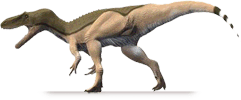
a carnivorous ceratosaurian theropod dinosaur from the Late Cretaceous of Egypt.
Pronunciation: buh-HAH-ree-yuh-SOR-us
Meaning: Bahariya lizard
Author/s: Stromer (
1934)
Synonyms: Deltadromeus? (Sereno
et al., 1996)
First Discovery: Bahariya, Egypt
Acta Ordinal: #178
Bahariasaurus ingens
(Massive Bahariya lizard)
Etymology
Bahariasaurus is derived from "Bahariya" (the Egyptian formation in which it was discovered) and the Greek "sauros" (lizard).
The
species epithet,
ingens, means "massive" in Latin.
Discovery
The remains of
Bahariasaurus were discovered in the Bahariya Formation at Gebel Ghorâbi, Bahariya (Arabic: "northern oasis"), Matruh, 300 km southwest of Cairo, Egypt, by Ernst Stromer and Richard Markgraf in 1911.
The
holotype (BSP 1922 X 47) consists of two dorsal (back) vertebrae, a neural arch, three sacral (hip) vertebrae, a rib fragment,
both pubes and an ischium fragment (hipbones). Tragically, it was destroyed in 1944, along with the holotypes
Spinosaurus,
Aegyptosaurus and other Bahariya fossils, when the Munich museum was hit by allied bombing raids during World War II.
Six partial tail vertebrae, belonging to seperate individuals from Niger's Farak Formation, were assigned to
Bahariasaurus by de Lapparent in 1960. But they likely belong to an unrelated theropod dinosaur.
• Stromer E (1934) "Ergebnisse der Forschungsreisen Prof. E. Stromers in den Wüsten Ägyptens. II. Wirbeltierreste der Baharîje-Stufe (unterstes Cenoman). 13. Dinosauria" [Results of the expeditions of Professor E. Stromer in the Egyptian deserts. II. Vertebrate animal remains from the Baharîje bed (lowest Cenomanian). 13. Dinosauria].
Abhandlungen der Bayerischen Akademie der Wissenschaften Mathematisch-naturwissenschaftliche Abteilung, Neue Folge 22:1-79
• de Lapparent AF (1960) "The dinosaurs of the “Continental Intercalaire” of the central Sahara".
Memoirs of the Geological Society of France, 39: 1-60.
• Rauhut OWM (1995) "Zur systematischen Stellung der afrikanischen Theropoden Carcharodontosaurus Stromer 1931 und Bahariasaurus Stromer 1934 [
The Systematic Position of the African Theropods
Carcharodontosaurus Stromer 1931 and Bahariasaurus Stromer 1934]".
Berliner Geowissenschaftliche
Abhandlungen, E, 16.1: 357-375.
• Smith JB, Lamanna MC, Lacovara KJ, Dodson P, Smith JR, Poole JC, Giegengack R and Attia Y (2001) "A Giant sauropod dinosaur from an Upper Cretaceous mangrove deposit in Egypt".
Science 292 (5522): 1704-1706. doi:10.1126/science.1060561
• Nothdurft WE and Smith JB (2003) "
The Lost Dinosaurs of Egypt: The Astonishing and Unlikely True Story of One of the Twentieth Century's Greatest Paleontological Discoveries".
• Farlow JO and Pianka ER (2002) "Body Size Overlap, Habitat Partitioning and Living Space Requirements of Terrestrial Vertebrate Predators: Implications for the Paleoecology of Large Theropod Dinosaurs".
Historical Biology, 16: 21–40. DOI: 10.1080/0891296031000154687.
• Maier G (2003) "
African Dinosaurs Unearthed: the Tendaguru Expeditions".
• Paul GS (2010) "
The Princeton Field Guide to Dinosaurs".
• Ibrahim N, Sereno PC, Varricchio DJ, Martill DM, Dutheil DB, Unwin DM, Baidder L, Larsson HCE, Zouhri S and Kaoukaya A (2020) "Geology and paleontology of the Upper Cretaceous Kem Kem Group of eastern Morocco".
ZooKeys, 928: 1-216. DOI: 10.3897/zookeys.928.47517.
• Cau A (2024) "A Unified Framework for Predatory Dinosaur Macroevolution".
Bollettino della Società Paleontologica Italiana, 63(1): 1-19. DOI: 10.4435/BSPI.2024.08.
• Cau A and Paterna A (2025) "Beyond the Stromer’s Riddle: the impact of lumping and splitting hypotheses on the systematics of the giant predatory dinosaurs from northern Africa".
Italian Journal of Geosciences, 144(2): (advance online publication). DOI: 10.3301/IJG.2025.10.
Time stands still for no man, and research is ongoing. If you spot an error, or want to expand, edit or add a dinosaur, please use
this form. Go
here to contribute to our FAQ.
All dinos are GM free, and no herbivores were eaten during site construction!
To cite this page:
Atkinson, L.
"
BAHARIASAURUS :: from DinoChecker's dinosaur archive".
‹
http://www.dinochecker.com/dinosaurs/BAHARIASAURUS›. Web access: 15th Oct 2026.