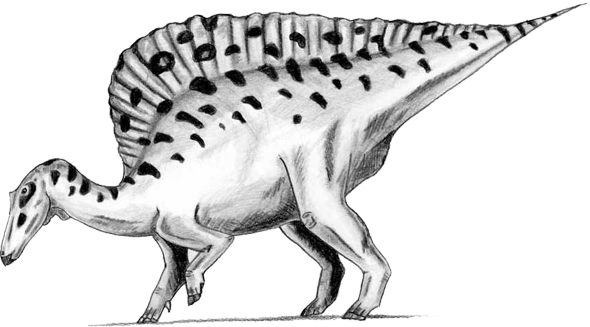
OURANOSAURUS
a plant-eating styracosternan iguanodontian dinosaur from the Early Cretaceous of Niger.
Pronunciation: yoo-RAY-no-SOR-us
Meaning: Brave lizard
Author/s: Taquet (
1976)
Synonyms: None known
First Discovery: Agadez, Niger
Acta Ordinal: #259
Ouranosaurus nigeriensis
(Brave Lizard from Niger)
Etymology
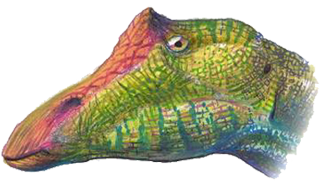 Ouranosaurus
 is derived from the Touareg "ourane" (what the Touareg of Niger and the Berbers of Algeria call the sand monitor) and the Greek "sauros" (lizard). Ourane itself is derived from "waran" (an Arabic term denoting bravery, valour, courage, and also recklessness) and is the source of the Latinised
Varanus, the generic name for monitor lizards.
The
species epithet (or specific name),
nigeriensis,
means "from Niger" in Latin.
The name
Ouranosaurus nigeriensis was first used by Taquet during the unveiling of the holotype at an exhibition organised by the Centre National de la Recherche Scientifique and the Muséum National d’Histoire Naturelle au Parc Floral de Vincennes in July 1972. It appeared again in an article in the journal "Sciences et Avenir" in September 1972, and again in the book "I Dinosauri del Teneré" in December 1972. None of those appearances were accompanied by a diognosis, so the name only became official when Taquet provided a detailed description in 1976.
Discovery
The first fossils of
Ouranosaurus were discovered at the "Camp of the two trees" in the "GAD 5" layer of the Elrhaz Formation, Gadoufaoua, 7 km South East of the wells of Elrhaz, Ténéré Desert, Niger (16°42' latitude. 9°20' longditude) by Philippe Taquet in January 1965.
The
holotype (MNHN GDF 300) is a practically complete skeleton, currently displayed in the National Museum of Niger at Niamey. A cast is displayed at the National Museum of Natural History in Paris, France.
Estimations
Timeline:
Era: Mesozoic
Epoch: Early Cretaceous
Stage: Aptian
Age range: 125-112 mya
Stats:
Est. max. length: 8 meters
Est. max. hip height: ?
Est. max. weight: 2.2 tons
Diet: Herbivore
References
• Taquet P (1970) "Sur le gisement de Dinosauriens et de Crocodiliens de Gadoufaoua (République du Niger)" [
On the dinosaurian and crocodilian locality of Gadoufaoua (Republic of Niger)].
Comptes Rendus de l'Académie des Sciences à Paris, Série D 271: 38-40. (English Translation by M. Carrano.)
• Ligabue M and Rossi-Osmida G (1975) "Gadoufaoua: Uadi dei dinosauri".
Relazione della spedizione scientifica “Ligabue” – Sahara 1973. Venice: Ed. Armena. 83 pp
• Taquet P (1976) "Geologie et paleontologie du gisement de Gadoufaoua (Aptien du Niger). Chapitre III: Ostéologie d'
Ouranosaurus nigeriensis,
Iguanodontidé du Crétacé Inférieur du Niger" [
Geology and Paleontology of the Gadoufaoua Deposit (Aptian-Albian). Chapter 3: "Osteology of Ouranosaurus nigerensis, Iguanodontid from the Lower Cretaceous of Niger].
Cahiers de Paléontologie, CNRS, Paris: 57-168 (English translation by Philip J Adds.)
• Padian and Currie (1997) "
Encyclopedia of dinosaurs".
• Bailey JB (1997) "Neural spine elongation in dinosaurs: sailbacks or buffalo-backs?".
Journal of Paleontology, 71(6): 1124-1146. DOI: 10.1017/S0022336000036076.
• Taquet P and Padian K (1998) "
Dinosaur Impressions: Postcards from a Paleontologist".
• Taquet P (1967) Découvertes paléontologiques récentes dans le nord du Niger" [Recent paleontological discoveries in the north of Niger]. Page 415-418 in "Problèmes
actuels de Paléontologie".
Éditions du Centre national de la recherche scientifique, Paris.
• Taquet P and Russell DA (1999) "A massively-constructed iguanodont from Gadoufaoua, Lower Cretaceous of Niger".
Annales de Paléontologie. 85(1): 85–96. DOI: 10.1016/s0753-3969(99)80009-3.
• Paul GS (2010) "
The Princeton Field Guide to Dinosaurs". (Page 292).
• Bertozzo F, Dalla Vechia FM and Fabbri M (2017) "The Venice specimen of
Ouranosaurus nigeriensis (Dinosauria, Ornithopoda)".
PeerJ, 5: e3403. DOI: 10.7717/peerj.3403.
Time stands still for no man, and research is ongoing. If you spot an error, or want to expand, edit or add a dinosaur, please use
this form. Go
here to contribute to our FAQ.
All dinos are GM free, and no herbivores were eaten during site construction!
To cite this page:
Atkinson, L.
"
OURANOSAURUS :: from DinoChecker's dinosaur archive".
‹
http://www.dinochecker.com/dinosaurs/OURANOSAURUS›. Web access: 07th Oct 2026.