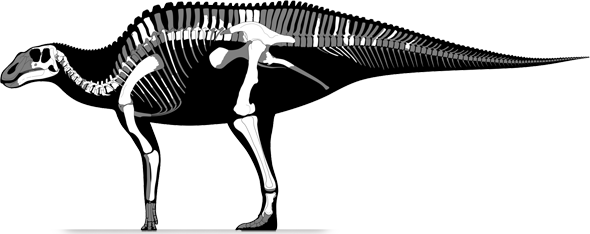
a herbivorous saurolophine hadrosaurid dinosaur from the Late Cretaceous of New Mexico.
Pronunciation: ah-SHIS-luh-SOR-rus
Meaning: Ah-shi-sle-pah Lizard
Author/s: Dalman
et al. (
2025)
Synonyms: None known
First Discovery: New Mexico, USA
Acta Ordinal: #1192
Ahshislesaurus wimani
(Wimans' Ah-shi-sle-pah Lizard)Etymology
Ahshislesaurus is derived from "Ah-shi-sle-pah" (for the Ah-shi-sle-pah Wash Wilderness study area) and the Greek "sauros" (lizard).
The
species epithet,
wimani, honours Carl Wiman, the pioneering Swedish paleontologist who studied vertebrate fossils from the region.
Its name is a phonetic transliteration of Navajo
áshįįh łibá meaning "salt, it is grey".
Zoobank registry:
urn:lsid:zoobank.org:act: 7841A554-66EC-4E76-BE9D-2950498649D6.
Discovery
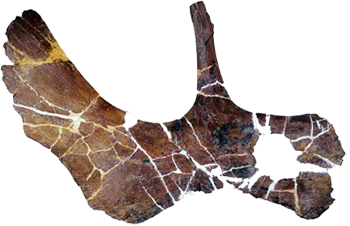
The remains of
Ahshislesaurus were discovered in the lower Hunter Wash
Member of the Kirtland Formation, 4 miles southwest of Kimbetoh, near Chaco
Canyon in the Ah-shi-sle-pah Wash Wilderness, San Juan County, New Mexico, in 1916 by Dr. J. B. Reeside Jr.
The
holotype (USNM VP-8629) is a partial skull—including pieces of the cheekbone (that looks suspiciously like a chasmosaurine ceratopsian skull in side view), jaw joint, and braincase—as well as the first (axis), third, and fourth neck vertebrae. But additional fossils from the Hunter Wash Member have expanded its story. A left lower jawbone (NMMNH P-66929) was formally referred to the species due to its close match with the holotype. A more complete specimen (NMMNH P-25057) shares similar neck vertebrae and may also belong to
Ahshislesaurus, though its assignment remains tentative. Other isolated bones—including a shoulder blade, upper arm bones, a lower arm bone, and a piece of hip—could represent
Ahshislesaurus. But the holotype lacks those parts for comparison, so they cannot be confidently assigned, and while they hint at a broader presence, multiple saurolophines likely roamed the region.
• Brown B (1910) "
The Cretaceous Ojo Alamo beds of New Mexico with description of the new dinosaur genus Kritosaurus".
Bulletin of the American Museum of Natural History, 28(24): 267–274. [names Kritosaurus navajovius.]
• Gilmore CW (1935) "
On the Reptilia of the Kirtland Formation of New Mexico, with the descriptions of new species of fossil turtles".
Proceedings of the United States National Museum, 83(2978): 159–188. DOI: 10.5479/si.00963801.83-2978.159.
• Horner JR, Weishampel DB and Forster CA (2004) "Hadrosauridae". Page 438–463 in Weishampel, Dodson and Osmólska (eds.) "
The Dinosauria: Second Edition".
• Prieto-Márquez A (2014) "Skeletal morphology of
Kritosaurus navajovius (Dinosauria: Hadrosauridae) from the Late Cretaceous of the North American south-west, with an evaluation of the phylogenetic systematics and biogeography of Kritosaurini".
Journal of Systematic Palaeontology, 12(2): 133-175. DOI: 10.1080/14772019.2013.770417.
• Sullivan RM and Lucas SG (2014) "Stratigraphic Distribution of Hadrosaurids in the Upper Cretaceous Fruitland, Kirtland, and Ojo Alamo Formations, San Juan Basin, New Mexico". Page 361-384 in Eberth and Evans (eds.) "
Hadrosaurs".
• Dalman SG, Jasinski SE, Malinzak DE, Lucas SG, Kundrát M and Fiorillo AR (2025) "A new saurolophine hadrosaurid (Ornithischia: Hadrosauridae) from the Upper Cretaceous (Campanian) Hunter Wash Member, Kirtland Formation, San Juan Basin, New Mexico".
In Lucas et al. (eds.) Fossil Record 11. New Mexico Museum of Natural History and Science Bulletin, 101: 73-114.
Time stands still for no man, and research is ongoing. If you spot an error, or want to expand, edit or add a dinosaur, please use
this form. Go
here to contribute to our FAQ.
All dinos are GM free, and no herbivores were eaten during site construction!
To cite this page:
Atkinson, L.
"
AHSHISLESAURUS :: from DinoChecker's dinosaur archive".
‹
http://www.dinochecker.com/dinosaurs/AHSHISLESAURUS›. Web access: 27th Oct 2026.