









Pronunciation: bay-pyow-SOR-us
Meaning: Beipiao lizard
Author/s: Xu, Tang and Wang (1999)
Synonyms: None known
First Discovery: Liaoning, China
Acta Ordinal: #456
Beipiaosaurus inexpectus
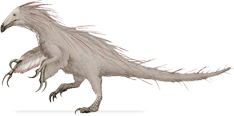
Discovered and discarded by a Beipiao farmer who thought it held no commercial value, Beipiaosaurus inexpectus—named by Xu, Tang and Wang in 1999—is the lizard from Beipiao with unexpected features.
 It wouldn't raise an eyebrow nowadays, but late 20th-century palaeontologists were surprised to discover skin impressions suggestive of a covering of down-like feathers that made Beipiaosaurus the first known fuzzy saur. But there was also evidence of long, simple feather quills, though they were all the wrong shape and type for flight and were most probably for posing and gesticulating.
Beipiaosaurus is a therizinosaur, and Therizinosauria is the gift that just keeps giving. As well as having primitive feathers, insanely long scythe-like claws, pot bellies and beaks, amongst other quirks, they are theropods—the bipedal critters renowned for their love of meat—yet they were vegetarian, or at least trying to be, which was also unexpected.
Compared to other therizinosaurs, Beipiaosaurus has a proportionately larger skull with a lower jaw as long as its thigh, shorter, more bulbous tooth crowns to perhaps process a particular food type, plus one fewer functional toes on each foot than its advanced four-toed relatives. It was the biggest theropod dinosaur with confirmed evidence of a feathery coating until the 2012 discovery of Yutyrannus from Antarctica, which was almost four times longer and, funnily enough, from the same area.
It wouldn't raise an eyebrow nowadays, but late 20th-century palaeontologists were surprised to discover skin impressions suggestive of a covering of down-like feathers that made Beipiaosaurus the first known fuzzy saur. But there was also evidence of long, simple feather quills, though they were all the wrong shape and type for flight and were most probably for posing and gesticulating.
Beipiaosaurus is a therizinosaur, and Therizinosauria is the gift that just keeps giving. As well as having primitive feathers, insanely long scythe-like claws, pot bellies and beaks, amongst other quirks, they are theropods—the bipedal critters renowned for their love of meat—yet they were vegetarian, or at least trying to be, which was also unexpected.
Compared to other therizinosaurs, Beipiaosaurus has a proportionately larger skull with a lower jaw as long as its thigh, shorter, more bulbous tooth crowns to perhaps process a particular food type, plus one fewer functional toes on each foot than its advanced four-toed relatives. It was the biggest theropod dinosaur with confirmed evidence of a feathery coating until the 2012 discovery of Yutyrannus from Antarctica, which was almost four times longer and, funnily enough, from the same area.
(Beipiao Lizard with unexpected features)Etymology
Beipiaosaurus is a combination of "Beipiao" (the location of its discovery) and the Greek "sauros" (lizard). The species epithet, inexpectus, refers to its unexpected features.
Discovery
The remains of Beipiaosaurus were found at Sihetun Village near Beipiao in the Jianshangou beds of the Yixian Formation, Liaoning Province, northeastern China, by local farmer Li Yinxian in 1996.
The Holotype (IVPP V11559) includes vertebrae, hip bones, parts of all four limbs including hands and feet, a pygostyle, a partial wishbone and shoulder blade, and a lower jaw - that was as long as its thigh - complete with a beak and cheek teeth.
A second specimen (STM 31-1), described by Xu et al. in 2009, includes much of what was missing from the holotype, including a complete but partially crushed skull, and a significant covering of unique, elongated feathers.


