









Pronunciation: na-nook-SOR-us
Meaning: Polar bear lizard
Author/s: Fiorillo and Tykoski (2014)
Synonyms: None known
First Discovery: Alaska, USA
Acta Ordinal: #875
Nanuqsaurus hoglundi
Although tyrannosaurines are well known to science and the public, thanks in no small part to the poster child Tyrannosaurus rex, they have all been discovered at latitudes no higher than southern Canada and central Asia.
Nanuqsaurus is based on remains from Alaska’s North Slope that were initially assigned to Gorgosaurus libratus, and while not literally "from the top of the world" in terms of altitude or global position, as the title of Fiorillo and Tykoski's 2014 paper explicitly states, it does come from the northernmost fringe of North America, an area that boasts the fifth closest point on land to the north pole.
Its remains don't amount to much, just three skull fragments found in close proximity, but they preserved enough anatomical detail to hold their own in robust cladistic tests. Fiorillo and Tykoski found Nanuqsaurus to be a fully-fledged adult tyrannosaurine closest to Tyrannosaurus and Tarbosaurus. However, the first two front teeth of its lower jaw are notably reduced in size compared to the others, which is a feature previously seen only in some juvenile specimens of the family.
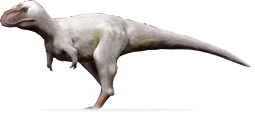
Nanuqsaurus was relatively small compared to most tyrannosaurines, but its six-metre length is not to be sniffed at, and was likely the optimal size for a predatory dinosaur in its environment. Cretaceous Alaska wasn't the Arctic wasteland it is today, but it still suffered profound seasonal shifts in daylight and extreme temperature fluctuations at certain times of the year, which limited the availability of meat-based edibles. Fortunately, Nanuqsaurus was the apex predator in its ecosystem, so everything was potential prey, and its surface area to volume ratio was low enough to minimise heat loss and thus stay warmer than smaller creatures in plummeting temperatures, so it was always primed for the hunt.
Its remains don't amount to much, just three skull fragments found in close proximity, but they preserved enough anatomical detail to hold their own in robust cladistic tests. Fiorillo and Tykoski found Nanuqsaurus to be a fully-fledged adult tyrannosaurine closest to Tyrannosaurus and Tarbosaurus. However, the first two front teeth of its lower jaw are notably reduced in size compared to the others, which is a feature previously seen only in some juvenile specimens of the family.
Nanuqsaurus was relatively small compared to most tyrannosaurines, but its six-metre length is not to be sniffed at, and was likely the optimal size for a predatory dinosaur in its environment. Cretaceous Alaska wasn't the Arctic wasteland it is today, but it still suffered profound seasonal shifts in daylight and extreme temperature fluctuations at certain times of the year, which limited the availability of meat-based edibles. Fortunately, Nanuqsaurus was the apex predator in its ecosystem, so everything was potential prey, and its surface area to volume ratio was low enough to minimise heat loss and thus stay warmer than smaller creatures in plummeting temperatures, so it was always primed for the hunt.
(Hoglund's Polar Bear Lizard)Etymology
Nanuqsaurus is derived from "nanuq" (the Iñupiaq word for polar bear) and the Greek "sauros" (lizard). The species epithet, hoglundi, honours Forrest Hoglund for his career in earth sciences and his philanthropic efforts in furthering cultural institutions.
ZooBank registry: urn:lsid:zoobank.org:act:7B5B4074-9A58-4AFC-BFD0-CDCA8D799432.
Discovery
The remains of Nanuqsaurus were discovered in the Prince Creek Formation at Kikak-Tegoseak Quarry, North Slope Borough, Alaska, USA, by Anthony R. Fiorillo and Ronald S. Tykoski in 2006.
The holotype (DMNH 21461, housed at the Perot Museum of Nature and Science, Texas) is three lumps of skull (a partial skull roof, and a piece each of the upper and lower jaw).
Preparators
Ronald S. Tykoski.


