




Pronunciation: JIG-an-OH-toe-SOR-us
Meaning: Giant southern lizard
Author/s: Coria and Salgado (1995)
Synonyms: None known
First Discovery: Neuquén, Argentina
Acta Ordinal: #408
Giganotosaurus carolinii
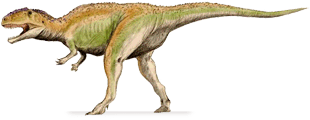
Giganotosaurus carolinii is possibly the most frequently mis-spelled dinosaur name of all time. People mostly omit the first "o" (as well as the last "i") but, in their defence, Giganotosaurus really was a giganto-saurus, just not the Gigantosaurus, which is a troublesome English sauropod, based on terribly fragmentary remains.
Discovered by car mechanic and keen amateur fossil hunter Ruben Carolini in the windy badlands of Patagonia, Giganotosaurus gave Tyrannosaurus rex the finger with its extra weight and length, and third finger. It also had a bigger skull, possibly the biggest ever at an estimated 1.95 meters in length according to some rather generous sources, but that's where the bragging rights end. Compared to T.rex, its skull was less deep and and somewhat slender, its teeth were shorter and thinner and more suited to slicing than crushing, its brain was only half the size, and François Therrien estimated that its bite force was a miserable 66% less using a method we're not going to pretend to understand. But it's not all bad news.
Update coming soon...
Discovered by car mechanic and keen amateur fossil hunter Ruben Carolini in the windy badlands of Patagonia, Giganotosaurus gave Tyrannosaurus rex the finger with its extra weight and length, and third finger. It also had a bigger skull, possibly the biggest ever at an estimated 1.95 meters in length according to some rather generous sources, but that's where the bragging rights end. Compared to T.rex, its skull was less deep and and somewhat slender, its teeth were shorter and thinner and more suited to slicing than crushing, its brain was only half the size, and François Therrien estimated that its bite force was a miserable 66% less using a method we're not going to pretend to understand. But it's not all bad news.
Update coming soon...
(Giant Southern Lizard)
Etymology
Giganotosaurus is derived from the Greek "gigas" (giant), "notos" (south) and "sauros" (lizard).
The species epithet, carolinii (CARE-oh-LEAN-ee-eye) honors Ruben Carolini, discoverer of its first fossils.
Discovery
The remains of Giganotosaurus were discovered in the Candeleros Formation (formerly the Rio Limay Formation) - the oldest formation of the Neuquén Group, 15 km south of Villa El Chocón, Neuquén, Argentina. The holotype, MUCPv-Ch1, housed at the Carmen Funes Museum in Neuquén, is a 70% complete skeleton including the skull (180cm long), pelvis, leg bones and most of the backbone.
Habitat
The Candeleros Formation is almost 300 meters thick in some sections. Overall, the formation represents an ancient braided river system, made up mostly of sandstones and conglomerates. There are also isolated sections that represent eolian (wind-blown) deposition, as well as siltstones deposited under swamp conditions. Paleosols (soil deposits) are common in some sections as well.


