









Pronunciation: ZAH-vuh-SEF-uh-lee
Meaning: Origin head
Author/s: Chinzorig et al. (2025)
Synonyms: None known
First Discovery: Dornogovi Province, Mongolia
Acta Ordinal: #1219
Zavacephale rinpoche
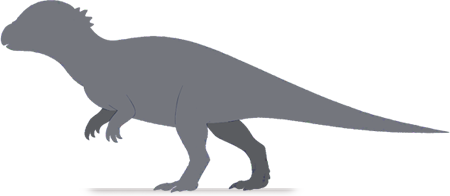
In the windswept exposures of Mongolia’s Khuren Dukh Formation, a fossil emerged that would upend the evolutionary timeline of pachycephalosaurs. Zavacephale rinpoche, a teenage "head banger" from the Early Cretaceous (circa 108 million years ago), now stands as the oldest and most complete member of its clade ever discovered. Its name—Zavacephale ("origin head") and rinpoche ("precious one")—reflects both its phylogenetic significance and the reverence inspired by its pristine preservation.
At barely a meter in length and weighing no more than six kilograms, Zavacephale may seem unassuming. Yet its anatomy tells a story of early innovation. Most striking is its fully formed skull dome: a structure dominated by the frontal bone (at the front), with only minimal contribution from the parietal (at the back) — a simpler architecture than the taller, more complex domes of later pachycephalosaurs. That a juvenile possessed such a well-developed dome suggests that cranial ornamentation began early in life, offering new clarity to long-standing debates over how dome shape varied with age versus species.
Equally groundbreaking is the discovery of the first-ever pachycephalosaur hand. Its preserved digits provide rare insight into limb function and posture, while the presence of gastroliths hints at digestive strategies suited to a herbivorous diet — a striking contrast to its pointed teeth, which resemble the omnivorous dentitions seen in other early pachycephalosaurs and historically caused confusion with Troodon. Ossified tendons along the tail suggest structural reinforcement—perhaps for balance, display, or even combat. Taken together, those features paint a portrait of a creature far more complex than its modest size implies.
Beyond its anatomical marvels, Zavacephale pushes the pachycephalosaur record back by roughly 15 million years, challenging assumptions about the pace and pattern of dome evolution. The shift from frontal-dominated domes in early forms to more elaborate, parietal-rich domes in later species may reflect deeper changes in behavior, ecology, or developmental pathways. In this way, Zavacephale not only expands the temporal boundaries of its lineage — it sharpens our understanding of how pachycephalosaurs grew, signaled, and evolved.
At barely a meter in length and weighing no more than six kilograms, Zavacephale may seem unassuming. Yet its anatomy tells a story of early innovation. Most striking is its fully formed skull dome: a structure dominated by the frontal bone (at the front), with only minimal contribution from the parietal (at the back) — a simpler architecture than the taller, more complex domes of later pachycephalosaurs. That a juvenile possessed such a well-developed dome suggests that cranial ornamentation began early in life, offering new clarity to long-standing debates over how dome shape varied with age versus species.
Equally groundbreaking is the discovery of the first-ever pachycephalosaur hand. Its preserved digits provide rare insight into limb function and posture, while the presence of gastroliths hints at digestive strategies suited to a herbivorous diet — a striking contrast to its pointed teeth, which resemble the omnivorous dentitions seen in other early pachycephalosaurs and historically caused confusion with Troodon. Ossified tendons along the tail suggest structural reinforcement—perhaps for balance, display, or even combat. Taken together, those features paint a portrait of a creature far more complex than its modest size implies.
Beyond its anatomical marvels, Zavacephale pushes the pachycephalosaur record back by roughly 15 million years, challenging assumptions about the pace and pattern of dome evolution. The shift from frontal-dominated domes in early forms to more elaborate, parietal-rich domes in later species may reflect deeper changes in behavior, ecology, or developmental pathways. In this way, Zavacephale not only expands the temporal boundaries of its lineage — it sharpens our understanding of how pachycephalosaurs grew, signaled, and evolved.
[Precious Origin Head]
Etymology
Zavacephale is derived from the Tibetan "zava" (origin) and the Greek "kephale" (head).
species epithet, rinpoche (RIN-po-chay), is a Tibetan honourific meaning "precious one". Often used to refer to revered teachers or spiritual figures, its inclusion here conveys the exceptional completeness and scientific value of the specimen.
ZooBank registry: urn:lsid:zoobank.org:act:ADA823FE-F284-44D3-A25C-515941A057C1.
Discovery
The remains of Zavacephale were discovered in the Khuren Dukh Formation at the Khuren Dukh locality, Dundgovi (Middle Gobi) Aimag (Province), Mongolia, in 2019.
The holotype (MPC-D 100/1209, housed in the Institute of Paleontology, Mongolian Academy of Sciences) is a partially articulated skeleton with a nearly complete skull.
Preparators
C. Bayardorj of the Mongolian Paleontological Center – Dinosaur collections (MPC-D) in the Institute of Paleontology and Geology at Ulaanbaatar, A. Giterman of North Carolina Museum of Natural Sciences (NCSM) at Raleigh, and B. Byambatsogt (MPC-D).


