ARRUDATITAN
an aeolosaurin lithostrotian sauropod frrom the Late Cretaceous of Brazil.
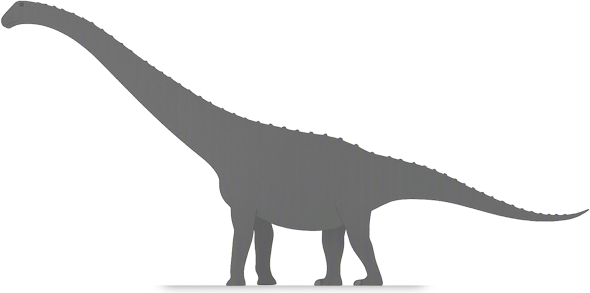
Pronunciation: ah-RU-da-TIE-tuhn
Meaning: Arruda Giant
Author/s: Silva Jr.
et al. (
2021)
Synonyms: Aeolosaurus maximus
First Discovery: São Paulo, Brazil
Acta Ordinal: #1081
Arrudatitan maximus
(The Largest Arruda Giant)Etymology
Arrudatitan is derived from "Arruda" (for late Professor Antonio de Celso Arruda Campos, fossil collector and first curator of the MPMA in Monte Alto) and the Greek "titan" (for the giant pre-Olympian deities of Greek mythology).
The
species epithet,
maximus, means "the largest" in Latin.
Discovery
The remains of
Arrudatitan were discovered in the Adamantina Formation (Bauru Group) at "Santa Irene" farm, near the border of Monte Alto and Cândido Rodrigues counties, São Paulo State, Brazil, by Ademir Frare and his 12-year-old nephew Luiz Augusto dos Santos Frare in 1997, excavated by staff of the Museu de Paleontologia de Monte Alto in 1997 and 1998, and first mentioned in scientific literature by Santucci and Bertini in 2001.
The
holotype (MPMA 12–0001-97) is two partial neck
vertebrae and seven partial neck ribs, three fragmentary back vertebra and twelve partial back ribs, eight tail vertebrae and eight chevrons, a probable fragmentary shoulder blade, a partial right upper arm, a left upper arm, a probably partial radius of the lower arm, a partial right thigh, a left thigh, a left ischium of the hip, and several unidentified fragments, that were assigned to
Aeolosaurus as
Aeolosaurus maximus by Santucci and De Arruda-Campos in 2011.
Referred material includes a tail vertebra (CPP 248, that was erroneously published as CPP 298 by Santucci and Bertini in 2001) and an osteoderm (CPP 297), from the Peirópolis locality in Uberaba county, Minas Gerais State, Brazil.
Estimations
Timeline:
Era: Mesozoic
Epoch: Late Cretaceous
Stage: Maastrichtian
Age range: 72-68 mya
Stats:
Est. max. length: 15 meters
Est. max. hip height: ?
Est. max. weight: ?
Diet: Herbivore
References
• Bertini RJ, Santucci RM and Arruda-Campos AC (1999) "First occurrence of
Aeolosaurus (Sauropoda, Titanosauridae) in Bauru Group of the Paraná
Basin, Brazil".
Congresso Brasileiro de Paleontologia, 16(1999): 27-28.
• Santucci RM and Bertini RJ (2001) "Distribuição paleogeográfica e biocronológica dos titanossauros (saurischia, sauropoda) do Grupo Bauru, Cretáceo superior do sudeste Brasileiro".
Revista Brasileira de Geociências, 31(3): 307–314.
• Novas FE (2009) "
The Age of Dinosaurs in South America".
• Candeiro C (2010) "Registro del género
Aeolosaurus (Sauropoda, Titanosauria) en el del Cretácico tardío de América del Sur: implicaciones paleogeográficas" [
Record of the genus Aeolosaurus (Sauropoda,
Titanosauria) in the Late Cretaceous of South America:
paleogeographic implications].
Estudios Geológicos, 66(2): 243-253.
DOI: 10.3989/egeol.40338.081.
• Martinelli A, Riff D and Lopes R (2011) "Discussões sobre a presença do gênero
Aeolosaurus powell 1987 (dinosauria, titanosauria) no cretáceo superior do Brasil" [
Discussion about the occurrence of the genus Aeolosaurus Powell 1987 (Dinosauria, Titanosauria) in the Upper Cretaceous of Brazil].
Gaea: Journal of Geoscience, 7(1): 34-40. DOI: 10.4013/gaea.2011.71.03.
• Santucci RM and de Arruda-Campos AC (2011) "A new sauropod (Macronaria, Titanosauria) from the Adamantina Formation, Bauru Group, Upper Cretaceous of Brazil and the phylogenetic relationships of Aeolosaurini".
Zootaxa, 3085: 1–33. DOI: 10.11646/zootaxa.3085.1.1.
• Silva Jr. JC, Martinelli AG, Iori FV, Marinho TS, Hechenleitner EM and Langer MC (2021) "Reassessment of
Aeolosaurus maximus, a titanosaur dinosaur from the Late Cretaceous of Southeastern Brazil".
Historical Biology: An International Journal of Paleobiology, 34(3): 403–411. DOI: 10.1080/08912963.2021.1920016.
Time stands still for no man, and research is ongoing. If you spot an error, or want to expand, edit or add a dinosaur, please use
this form. Go
here to contribute to our FAQ.
All dinos are GM free, and no herbivores were eaten during site construction!
To cite this page:
Atkinson, L.
"
ARRUDATITAN :: from DinoChecker's dinosaur archive".
‹
http://www.dinochecker.com/dinosaurs/ARRUDATITAN›. Web access: 23rd Oct 2026.