





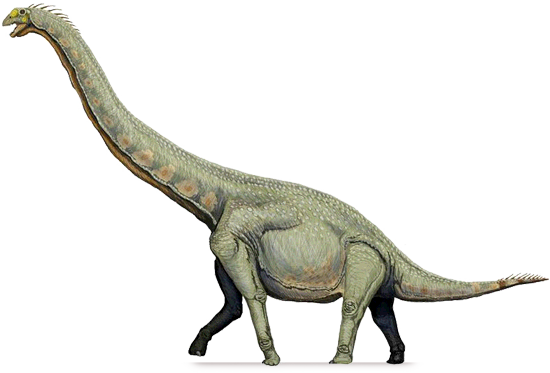
Pronunciation: yoo-HEL-o-pus
Meaning: Good marsh foot
Author/s: Romer (1956)
Synonyms: Helopus (Wiman, 1929)
First Discovery: Shandong, China
Acta Ordinal: #206
Euhelopus zdanskyi
The first remains of Euhelopus were initially named Helopus ("marsh foot") in 1929 by Carl Wiman, who likened its broad-soled hind feet with splayed toes to "trugors": a type of shoe worn in northern Sweden by man and horse to prevent sinkage into loose snow and soft, swampy ground. Furthermore, he was convinced that Helopus spent long periods submerged in water using its nostrils as a snorkel, despite noting that the vertebral column was highly pneumatic (full of airy spaces) and thus would surely float. Since then, the water-dwelling sauropod theory has been dismantled, and the name Helopus turned out to be pre-occupied, funnily enough, by a water bird (Helopus caspius, Wagler 1832). Romer's 1956 replacement name, Euhelopus, was pre-occupied too, but by a type of grass from a different biological kingdom, so a nameshare isn't an issue. Ironically, Helopus (the bird) was later sunk as a junior synonym of Hydroprogne caspia (Kaup, 1829) which is commonly known as "the Caspian Tern". Euhelopus has never been straightforward, with many a twist and tern.
Father R. Mertens first spotted its remains while working as a missionary in Mengyin County in 1913, then three of its vertebrae found their way to an intrigued German mining engineer named W. Behegel, who forwarded them to Dr V. K. Ting at the Geological Survey of China in 1916. Six more years passed before the institutes' Hsi Chou T'an and Swedish geologist-come-mining advisor J. Gunnar Anderson managed to locate the fossil site. But they needed the help of Father Alfred Kaschel — who knew, roughly, the whereabouts of Mertens' initial find, and Austrian PhD student Otto Zdansky — who was only there because Anderson's friend and first choice assistant (eventual name-coiner Carl Wiman) was bogged down with teaching duties and other commitments at Uppsala University and couldn't make the trip himself. Zdanski began excavations at two quarries some 3km apart in 1923, recovering a partial skeleton at each and sending them to his mentor (Wiman) who eventually got to do his thing. CC Young and N. Bien returned to the site in 1934 to recover material that Zdansky had left behind as he was obliged to pack up his tools and return to Beijing, though, apparently, not before joining T'an in Laiyang and making a pigs ear of excavating a hadrosaur called Tanius.
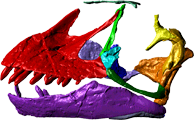 With the three specimens found by three different parties at three different times, Euhelopus is one of the best-represented sauropods in the fossil register and was the first Chinese sauropod to be described. It's also one of the few sauropods from anywhere that owns a well-represented skull (including bits that have only recently appeared in the literature and more fragments that lay as-yet un-prepared), which was seriously scrutinised by Poropat and Kear in 2016. Its forelegs are longer than its hind legs, but not as long as those of brachiosaurids, and its neck is unusually long (17 vertebrae), which has led to several cases of mistaken identity.
Euhelopus has often been confused with the noodle-necked Mamenchisaurus and/or Omeisaurus, and sometimes the three, plus others, are plonked in Euhelopodidae: a clade that Alfred Sherwood Romer coined in 1956 when he renamed Helopus, with Euhelopus as the name-bearer. However, Mamenchisaurus anchors its own family (Mamenchisauridae) these days. At the same time, Euhelopus (and Euhelopodidae, for those who think it's still valid) seems to belong to Tiitanosauriformes, specifically Somphospondyli. Given that the affinities of sauropods, particularly those from China, are in a constant state of flux, we wouldn't dare guess what the closest relatives of Euhelopus currently are.
Father R. Mertens first spotted its remains while working as a missionary in Mengyin County in 1913, then three of its vertebrae found their way to an intrigued German mining engineer named W. Behegel, who forwarded them to Dr V. K. Ting at the Geological Survey of China in 1916. Six more years passed before the institutes' Hsi Chou T'an and Swedish geologist-come-mining advisor J. Gunnar Anderson managed to locate the fossil site. But they needed the help of Father Alfred Kaschel — who knew, roughly, the whereabouts of Mertens' initial find, and Austrian PhD student Otto Zdansky — who was only there because Anderson's friend and first choice assistant (eventual name-coiner Carl Wiman) was bogged down with teaching duties and other commitments at Uppsala University and couldn't make the trip himself. Zdanski began excavations at two quarries some 3km apart in 1923, recovering a partial skeleton at each and sending them to his mentor (Wiman) who eventually got to do his thing. CC Young and N. Bien returned to the site in 1934 to recover material that Zdansky had left behind as he was obliged to pack up his tools and return to Beijing, though, apparently, not before joining T'an in Laiyang and making a pigs ear of excavating a hadrosaur called Tanius.
With the three specimens found by three different parties at three different times, Euhelopus is one of the best-represented sauropods in the fossil register and was the first Chinese sauropod to be described. It's also one of the few sauropods from anywhere that owns a well-represented skull (including bits that have only recently appeared in the literature and more fragments that lay as-yet un-prepared), which was seriously scrutinised by Poropat and Kear in 2016. Its forelegs are longer than its hind legs, but not as long as those of brachiosaurids, and its neck is unusually long (17 vertebrae), which has led to several cases of mistaken identity.
Euhelopus has often been confused with the noodle-necked Mamenchisaurus and/or Omeisaurus, and sometimes the three, plus others, are plonked in Euhelopodidae: a clade that Alfred Sherwood Romer coined in 1956 when he renamed Helopus, with Euhelopus as the name-bearer. However, Mamenchisaurus anchors its own family (Mamenchisauridae) these days. At the same time, Euhelopus (and Euhelopodidae, for those who think it's still valid) seems to belong to Tiitanosauriformes, specifically Somphospondyli. Given that the affinities of sauropods, particularly those from China, are in a constant state of flux, we wouldn't dare guess what the closest relatives of Euhelopus currently are.
(Good marsh foot)Etymology
Euhelopus is derived from the Greek "eu" (good, true), "helos" (marsh) and "pous" (foot), alluding to the broad-soled hind feet that Wiman supposed belonged to a marsh-dwelling critter.
The species epithet, zdanskyi, honours Austrian palaeontologist Otto Zdansky who excavated most of its remains.
Discovery
The first remains of Euhelopus zdanskyi were discovered in the Mengyin Formation, Shandong Province, China, by Father R. Mertens in 1913.
The holotype (PMU R233, tagged by Wiman as "exemplar a") includes a partial skull, twenty-four vertebrae from the neck and back, a rib, and a left thigh, collected by Otto Zdansky in March 1923.
A second specimen (PMU 234, tagged by Wiman as "exemplar b") was found in a quarry 2-3km from the first and includes a series of nine back vertebrae and a block of six fused hip vertebrae (sacrum), a nearly complete pelvis, and a hind leg missing a few foot bones, collected by Otto Zdansky in March 1923.
A third specimen (referred to as "exemplar c" by Wilson and Upchurch in 2009 but possibly belonging to "exemplar a") was found by Young and Bien in the same quarry as the type specimen in Autumn 1934 and includes four back vertebrae, a left shoulder girdle and upper arm. No specimen number was assigned, and their whereabouts are unknown.


