









Pronunciation: ep-id-ecks-IP-tuh-ricks
Meaning: Display feather
Author/s: Zhang et al. (2008)
Synonyms: None known
First Discovery: Ningcheng, China
Acta Ordinal: #670
Epidexipteryx hui
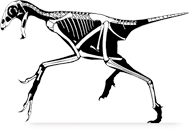
Everything we know about Epidexipteryx we know from a single specimen preserved on two slabs of Daohugou sandstone, and everything about it is unusual. Only 25cm in length with insanely long arms and hands with three fingers (the longest of which was on the outside), a high skull with a stumpy snout, broad feet, long pointed "fangs" at the front of the upper jaw and even longer ones in the lower jaw, Epidexipteryx looked like a weird spindly-armed vampire pigeon. But looks can be deceiving.
Okay, it is weird, but its long arms and fingers were ideal for climbing trees and poking at crevices, and its pointy front pegs, far from being for blood sucking, or even flesh eating, were arranged in such a way that those of the upper and lower jaws could interlock when the mouth was closed, which is a design well suited to snagging elusive insects. Although Epidexipteryx preserved two types of feathers, neither was the contour variety, so it couldn't fly or even glide. Still, we'll bet it was always warm and never short of a mate.
Lovingly referred to as "Húshì Yàolóng (Hu Yaoming's display dragon) on Chinese news sites, even after it was officially named, Epidexipteryx was covered in feathery fuzz for insulation and represents the earliest known example of ornamental feathers in the fossil record. It sported two pairs of long ribbon-like display feathers, attached to a pygostyle (parsons nose), which almost doubled its total length, with only two reasons for such ostentatious finery: to tell the opposite sex you're the bird of their dreams and to let rivals know you're so much better than they are.
Okay, it is weird, but its long arms and fingers were ideal for climbing trees and poking at crevices, and its pointy front pegs, far from being for blood sucking, or even flesh eating, were arranged in such a way that those of the upper and lower jaws could interlock when the mouth was closed, which is a design well suited to snagging elusive insects. Although Epidexipteryx preserved two types of feathers, neither was the contour variety, so it couldn't fly or even glide. Still, we'll bet it was always warm and never short of a mate.
Lovingly referred to as "Húshì Yàolóng (Hu Yaoming's display dragon) on Chinese news sites, even after it was officially named, Epidexipteryx was covered in feathery fuzz for insulation and represents the earliest known example of ornamental feathers in the fossil record. It sported two pairs of long ribbon-like display feathers, attached to a pygostyle (parsons nose), which almost doubled its total length, with only two reasons for such ostentatious finery: to tell the opposite sex you're the bird of their dreams and to let rivals know you're so much better than they are.
(Hu's display feather)Etymology
Epidexipteryx is derived from the Greek "Epidexi" (display) and "pteryx" (feather or wing) in reference to the four ribbon-like display feathers preserved with its remains.
The species epithet, hui, honors Hu Yaoming, a young, deceased Chinese paleomammalogist, who contributed significantly to the study of Mesozoic mammals from China. Seemingly baffled by modern technology, Fucheng Zhang et al. uploaded their manuscript in which this critter was named to "Nature" in late September 2008, believing that it would undergo peer review before its official publication. What they actually did was upload it to the wrong website and make it publicly viewable in all its glory, but that little boo-boo was rectified a month later, so the official publication date is October 23rd, 2008. Certain palaeontologists rallied to have its name changed to mask this publication error, but to no avail.
Discovery
The remains of Epidexipteryx were discovered in the Tiaojishan Formation (sometimes referred to as the "Haifanggou" Formation) at Daohugou Village, Ningcheng County, Nei Mongol (Inner Mongolia), China.
The holotype (IVPP V15471—housed at the Institute of Vertebrate Paleontology and Paleoanthropology, Chinese Academy of Sciences, Beijing) is a nearly complete pigeon-sized skeleton with feather impressions, preserved on part and counterpart slabs.
Preparator
Y. Li.


