









Pronunciation: sor-OHR-nith-o-LESS-teez
Meaning: Lizard bird thief
Author/s: Sues (1978)
Synonyms: None known
First Discovery: Alberta, Canada
Acta Ordinal: #270
Saurornitholestes langstoni
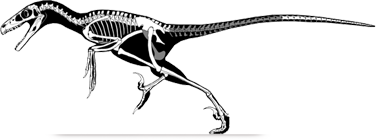
A small, swift predator of the Late Cretaceous, Saurornitholestes langstoni lived in the floodplains and river-cut forests of western North America around 76–72 million years ago. About two metres long and lightly built, it was a member of Dromaeosauridae — a family of predatory dinosaurs known colloquially as "raptors" — and within that group, it anchors its own sub-family, Saurornitholestinae.
Its long legs, grasping hands, and recurved teeth point to a hunter specialised for quick pursuits and precise strikes, preying on small vertebrates and scavenging when opportunities arose. The skull was fairly robust for a modestly sized animal, and it bore a distinctive flattened front tooth likely used for preening feathers — a rare behavioural clue to how this dinosaur, almost certainly feathered despite the lack of direct evidence, maintained its plumage.
Although first known from fragmentary remains, later discoveries—including an exceptionally complete skeleton preserved in life position—reveal a predator far more anatomically refined than once assumed. Saurornitholestes langstoni carried a stiffened tail for balance, an enlarged sickle-claw on the second toe for gripping, and a body built for agility. Its fossils appear across several formations in Alberta and Montana, showing that this nimble hunter persisted across a wide span of Campanian time and played a consistent role in ecosystems dominated by hadrosaurs, ceratopsians, and tyrannosaurids.
Its long legs, grasping hands, and recurved teeth point to a hunter specialised for quick pursuits and precise strikes, preying on small vertebrates and scavenging when opportunities arose. The skull was fairly robust for a modestly sized animal, and it bore a distinctive flattened front tooth likely used for preening feathers — a rare behavioural clue to how this dinosaur, almost certainly feathered despite the lack of direct evidence, maintained its plumage.
Although first known from fragmentary remains, later discoveries—including an exceptionally complete skeleton preserved in life position—reveal a predator far more anatomically refined than once assumed. Saurornitholestes langstoni carried a stiffened tail for balance, an enlarged sickle-claw on the second toe for gripping, and a body built for agility. Its fossils appear across several formations in Alberta and Montana, showing that this nimble hunter persisted across a wide span of Campanian time and played a consistent role in ecosystems dominated by hadrosaurs, ceratopsians, and tyrannosaurids.
(Langston's lizard bird thief)Etymology
Saurornitholestes is derived from the Greek "sauros" (lizard), "ornis" (bird) and "lestes" (thief), in reference to Saurornithoididae: a 1974 Barsbold-named group of small theropod dinosaurs to which it was initially assigned. As it happens, Saurornithoididae turned out to be synonymous with Troodontidae, and Saurornitholestes went on to anchor its own dromaeosaurid sub-family; Saurornitholestinae.
The species epithet, langstoni, honors Wann Langston Jr., a Texan palaeontologist who worked in Alberta during the 1950s.
Discovery
The first remains of Saurornitholestes were found in "RTMP Quarry 140" in the Dinosaur Park Formation (Belly River Group) at Steveville, Alberta, Canada, by Mrs. Irene Vanderloh (of Cessford, Alberta) in 1974.
The holotype (RTMP 74.10.5) is a fragmentary skeleton, including a hand, some teeth, two vertebrae, ribs, skull fragments, and a partial tail. Three skull bones known as frontals (CMN 12343, CMN 12354, and UA 5283) were designated as paratypes.
A specimen of Saurornitholestes found by Clive Coy (UALVP 55700) in Dinosaur Provincial Park in 2014 is the most remarkably complete and exquisitely preserved raptor skeleton ever found in North America, with all the bones, except for the tail, preserved in life position.
In 2001, Aase Roland Jacobsen published a description of a Saurornitholestes lower jaw bone from Alberta's Dinosaur Park Formation, with three tooth marks, likely made by a juvenile of one of the area's tyrannosaurids, Gorgosaurus or Daspletosaurus.
Additional material includes two large and fairly complete partial skeletons (RTMP 88.121.39 and MOR 660), as well as dozens of isolated bones, numerous teeth, and fossil fragments from the Oldman Formation of Alberta, the Two Medicine Formation of Alberta and Montana, the Mooreville Chalk of Alabama, and the Coachman and Donoho Creek formations of South Carolina.
The most recent discovery, is an isolated tooth (UALVP 60509), collected at Bonebed 234 in the Dinosaur Park Formation of Alberta's Dinosaur Provincial Park on 27 May 2019 by Jacob Atwood.


