




Pronunciation: CHING-DOW-SOR-us
Meaning: Qingdao lizard
Author/s: Yang (1958)
Synonyms: None known
First Discovery: Shandong, China
Acta Ordinal: #210
Tsintaosaurus spinorhinus
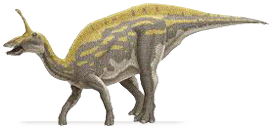
Tsintaosaurus is a lambeosaurine (a hadrosaur with headgear) and hails from the Jingangkou Formation of China's Shandong Province. Its headcrest is long, but differs from the long crest of Saurolophus (which is a partially hollow spike that projects backwards beyond the rear of its skull and may have had some sort of respiratory function) in being a thin, sealed-at-the-base prong that juts forwards and upwards from its forehead, like a unicorn's horn but with a weird bony lump at the tip.
This critters appendage (or lack of) caused paleontology's version of a civil war when two of France's top dinosaur experts couldn't agree less. Philippe Taquet was adamant that it was simply a smashed nose bone that had been forced upwards during fossilisation, backed up by a seemingly perfectly matching slot down the midline of its snout. Furthermore, without the distinctive "crest" Tsintaosaurus was a dead ringer for Tanius—a crestless hadrosaur from the same formation whose remains may have mingled with those of Tsintaosaurus. Unconvinced, Eric Buffetaut searched for and found a second specimen with an identical "crest" (and slot) which kept the serial synonymizers at bay but, alas, it brought no clues as to its function, though a mast for a sail to impress the opposite sex is a popular theory.
In 2013, Prieto-Márquez came to the conclusion that the unicorn-like bone of Tsintaosaurus was merely the rear part of a much larger crest that started at the front of its snout, continued backwards in the form of raised nasal bones, and ended with a somewhat bulbous structure on the top of its skull, but this latest theory is based on the restudy of remains that are sadly lacking in the raised nasal bones and bulbous structure department.
This critters appendage (or lack of) caused paleontology's version of a civil war when two of France's top dinosaur experts couldn't agree less. Philippe Taquet was adamant that it was simply a smashed nose bone that had been forced upwards during fossilisation, backed up by a seemingly perfectly matching slot down the midline of its snout. Furthermore, without the distinctive "crest" Tsintaosaurus was a dead ringer for Tanius—a crestless hadrosaur from the same formation whose remains may have mingled with those of Tsintaosaurus. Unconvinced, Eric Buffetaut searched for and found a second specimen with an identical "crest" (and slot) which kept the serial synonymizers at bay but, alas, it brought no clues as to its function, though a mast for a sail to impress the opposite sex is a popular theory.
In 2013, Prieto-Márquez came to the conclusion that the unicorn-like bone of Tsintaosaurus was merely the rear part of a much larger crest that started at the front of its snout, continued backwards in the form of raised nasal bones, and ended with a somewhat bulbous structure on the top of its skull, but this latest theory is based on the restudy of remains that are sadly lacking in the raised nasal bones and bulbous structure department.
Etymology
Tsintaosaurus is derived from "Tsingtao" which is the old transliteration of "Qingdao" (Chinese qing "green" and dao "island") the city on the west coast of China's Shandong Province close to its place of discovery, and the Greek "sauros" (Lizard). Tsingtao is also the largest brewery in China, founded by an English-German company in 1903 who bought it with Mexican dollars. Barring its location there's no link, we just thought you might like to know.
The species epithet, spinorhinus,
refers to the spine-like crest on its head.
ZooBank registry: urn:lsid:zoobank.org:act:F2B1968D-6C6C-4C6B-A527-362DB6D3D3C5.
Discovery
The fossils of Tsintaosaurus were discovered in the Jingangkou Formation (Wangshi Series), Shandong, China, by C.C. Young (aka Yang Zhongjian) in 1950.
The holotype (IVPP AS V725) is a partial skull and a few bits of skeleton.


