









Pronunciation: KAMP-toe-SOR-us
Meaning: Flexible lizard
Author/s: Marsh (1885)
Synonyms: See below
First Discovery: Wyoming, USA
Acta Ordinal: #64
Camptosaurus dispar
Camptosaurus dispar was discovered by William Harlow Reed on September 4th, 1879, in the Morrison Formation's "Quarry 13". But its partial skeleton was initially named Camptonotus — from the Greek "kamptos" (flexible) and "notos" (back) — by Professor Othniel Charles Marsh because of the presumed flexibility of its unfused hip vertebrae. Marsh was soon in despair when he realised that Uhler and his lousy leaf-rolling cricket had beaten him to the punch, name-wise, in 1864, so he settled on Camptosaurus as a replacement in 1885. Over a century's worth of mess followed, with specimens assigned to it, often with their own epithets, from around the globe. But after a monumental clean-up job, only the original Camptosaurus dispar is left standing.
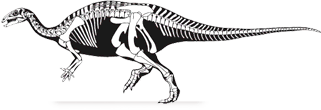
Camptosaurus was heavily built for its size, with robust hind limbs and broad, four-toed feet. It had small thumb spikes and short fingers, and its wrists were reinforced with bony struts, so it was probably comfortable on all fours, at least while grazing. A somewhat triangular head with a long, beak-ended snout was full of tightly packed teeth, which in all known specimens show signs of heavy wear. However, it wasn't the quantity of chow that was taking its toll on their pegs but the quality, or lack of; Camptosaurus were much less fussy than modern-day vegetarians and would happily chew on twigs and tough vegetation in the absence of magic bean curd, quinoa or tender golden grass plucked by angels. Chef's dream.
Camptosaurus was heavily built for its size, with robust hind limbs and broad, four-toed feet. It had small thumb spikes and short fingers, and its wrists were reinforced with bony struts, so it was probably comfortable on all fours, at least while grazing. A somewhat triangular head with a long, beak-ended snout was full of tightly packed teeth, which in all known specimens show signs of heavy wear. However, it wasn't the quantity of chow that was taking its toll on their pegs but the quality, or lack of; Camptosaurus were much less fussy than modern-day vegetarians and would happily chew on twigs and tough vegetation in the absence of magic bean curd, quinoa or tender golden grass plucked by angels. Chef's dream.
Camptosaurus confusion
Camptosaurus amplusThe fossil that O.C. Marsh used to name Camptosaurus amplus in 1879 is "YPM 1887", a foot found by Arthur Lakes at Quarry 1A in the Morrison Formation at Como Bluff... that actually belonged to Allosaurus! A skull assigned here in 1886 on the assumption it was from the same area was used by Gilmore to correct Marsh's 1894 reconstruction of Camptosaurus dispar in 1909 and became the blueprint for all future reconstructions of Camptosaurus. However, microscopic comparisons of the Mesozoic Formations convinced Brill and Carpenter that this skull was neither from the Morrison nor did it belong to Camptosaurus, and they used it to raise Theiophytalia kerri in 2006. Camptosaurus nanus
Camptosaurus nanus (Marsh, 1894) also from the Morrison Formation's "Quarry 13" was sunk into Camptosaurus dispar (the name-bearing specimen) by Peter Galton and H.P. Powell in 1980. Camptosaurus medius
Camptosaurus medius (Marsh, 1894), also from the Morrison Formation's "Quarry 13", was also sunk into Camptosaurus dispar (the name bearing specimen) by Peter Galton and H.P. Powell in 1980, then Carpenter and Wilson highlighted obvious differences between the two and moved the remains to Camptosaurus aphanoecetes in 2008. Andrew T. McDonald renamed it Uteodon aphanoecetes in 2011. Camptosaurus browni
Camptosaurus browni was named by Gilmore in 1909 based on a partial skeleton plucked from Marsh's "Quarry 13" material. Galton and Powell (1980) considered it to be a growth stage of Camptosaurus dispar. Camptosaurus depressus
Camptosaurus depressus was named by Gilmore in 1909 for remains from the Lakota Formation's Chilson Member near the town of Hot Springs, South Dakota. The holotype (USNM 4753) was moved to Planicoxa depressa (Carpenter, 2008) then to Osmakasaurus depressus (Andrew Mcdonald, 2011). It's all very depressing. Camptosaurus hoggi
Originally named Iguanodon hoggii by Owen in 1874, its holotype dentiary—discovered in the Lulworth Formation of England's Durlston Bay—was shipped-off to Camptosaurus hoggi by Norman and Barrett in 2002, but it was renamed Owenodon by Galton in 2009. Camptosaurus prestwichii
Discovered in the Chawley Brick Pits at Cumnor when quarrymen drove a tramway through a hillside to transport their wares, Camptosaurus prestwichii was originally described as "belonging to Iguanodon" by Joseph Prestwich in 1879. John Whitaker Hulke added an epithet in honoUr of Prestwich in 1880, but it was placed in its own genus—Cumnoria prestwichii—by Harry Govier Seeley in 1888, then Richard Lydekker renamed it Camptosaurus prestwichii a year later. Almost a century passed before Galton and Powell assigned Iguanodon prestwichi to Camptosaurus... again... like Lydekker 1888 had never happened, but Camptosaurus prestwichii became Cumnoria once more when Andrew McDonald realised that Seeley was right all along. Camptosaurus inkeyi
Camptosaurus inkeyi, from Romania's Hateg Basin, consists of fragmentary material and is no longer considered valid. Camptosaurus leedsi
Based on the holotype BMNH R1993, a nearly complete left thigh bone collected from the Peterborough Member (former Lower Oxford Clay) of the Oxford Clay Formation of Fletton, near Peterborough, Richard Lydekker named Camptosaurus leedsi in 1889. Peter Galton renamed these remains Callovosaurus in 1980. Camptosaurus valdensis
The Camptosaurus valdensis holotype, based on a poorly preserved left femur, catalogued as NHMUK R167, was assigned to Valdosaurus canaliculatus by Peter Galton in 1977. A review by Andrew Mcdonald in 2011 found it to be an indeterminate dryosaurid. Camptosaurus aphanoecetes
Camptosaurus aphanoecetes, based on a partial skeleton from the Brushy Basin Member of the Morrison Formation, Dinosaur National Monument, Utah, was originally named Camptosaurus medius and later referred to Camptosaurus dispar. Carpenter and Wilson pointed to obvious differences as reason to move its remains (CM 11337 - a partial skeleton) to Camptosaurus aphanoecetes in 2008. But it was renamed Uteodon aphanoecetes a mere three years later.
Etymology
Camptosaurus is derived from the Greek "kamptos" (bent/flexible) and "sauros" (lizard) based on Marsh's assumption that a "peculiar peg-and-notch articulation" (rather than being fused) would afford its hip vertebrae great flexibility.
Synonyms
Brachyrophus altarkansanus (Cope 1878),Symphyrophus musculosus (Cope 1878),
Camptosaurus medius (Marsh 1894),
Camptosaurus nanus (Marsh 1894),
Camptosaurus browni (Gilmore 1909)
.
Discovery
The remains of Camptosaurus dispar were discovered at "Quarry 13" in the Salt Wash Member of the Morrison Formation, Como Bluff, Albany County, Wyoming, USA, by William Harlow Reed on September 4th, 1879. The holotype (YPM 1877) is a partial skeleton.


