


Pronunciation: ta-tah-wee-nee-uh
Meaning: for Tataouine
Author/s: Fanti et al. (2013)
Synonyms: None known
First Discovery: Tataouine, Tunisia
Acta Ordinal: #863
Tataouinea hannibalis
A long time ago (well, 2013) in a galaxy (okay, a land!) far, far away, Federico Fanti and chums named a rebbachisaurid diplodocoid sauropod Tataouinea. Alas, it wasn't named after the planet Tatooine in Star Wars, where the Skywalkers lived, but for the Tunisian province of Tataouine, which was George Lucas's inspiration for the planet's buildings and landscape. Due to the Star Wars link, and being huge fans of the movie themselves, the authors were tempted to assign Tataouinea the specific name "skywalkeri". But in the end, they decided to honour a real Tunisian warrior, Hannibal Barca, a Carthaginian general famous for his war elephants.
Palaeontologists have been advocating for years the similarity between certain types of extinct dinosaurs and birds, particularly highlighting a feature known as pneumatization: the presence of cavities in bone caused by the invasion of air sacs. In the case of birds, these sacs are attached both infront and behind a set of rigid lungs, and work thus; fresh air enters the rear sacs from the nostrils, is forced through the lungs, then passes into the front sacs as new air refills the rear ones, the old air exits the nostrils as the rear sacks fill the lungs, and so it continues. In effect, they are breathing in and out simultaneously, so their body tissue has a constantly high level of oxygen to fuel the insane energy levels required for flying.
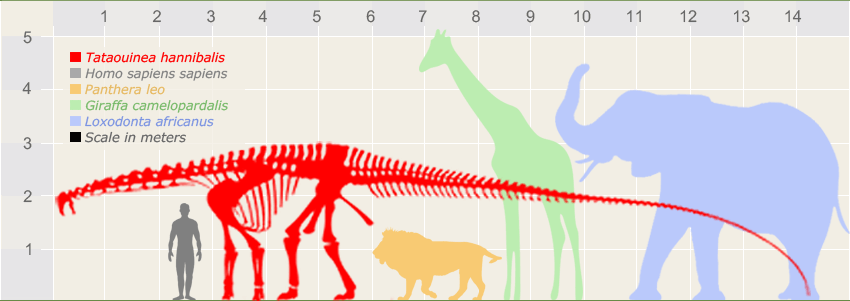
Given their holy bones and similar general layout (barring wings in some species), plus the fact that modern birds are living theropods, it comes as little surprise that theropod dinosaurs, like Aerosteon, had a breathing system similar to birds. What may be a little surprising is that the same cavities are found in the bones of Tataouinea hannibalis, a four-legged, fourteen-metre-long, plant-eating diplodocoid, and also in the bones of some saltasaurine titanosaurs and brachiosaurids, which suggests sauropod dinosaurs probably breathed like birds, too.
Of course, the "Aero bone" theory is nothing new. It was being sold by Richard Owen and Becklespinax (then part of Megalosaurus) as early as 1856. Still, no one was buying (apart from Harry Seeley and Ornithopsis) until the earliest part of the 21st century when the likes of Matt Wedel began digging into the origin of the avian (bird) lung, holy bones and their implications for mass estimates in sauropods. As well as "flow through" breathing, which may have afforded dinosaurs a high oxygen level to fuel quick growth, the invading air sacs also lightened their bones without compromising bone strength, so while the likes of Tataouinea, with its extensively pneumatic skeleton, looked like a huge and heavy oaf on the outside, it may have just been a huge oaf but not as heavy as it looked.
Palaeontologists have been advocating for years the similarity between certain types of extinct dinosaurs and birds, particularly highlighting a feature known as pneumatization: the presence of cavities in bone caused by the invasion of air sacs. In the case of birds, these sacs are attached both infront and behind a set of rigid lungs, and work thus; fresh air enters the rear sacs from the nostrils, is forced through the lungs, then passes into the front sacs as new air refills the rear ones, the old air exits the nostrils as the rear sacks fill the lungs, and so it continues. In effect, they are breathing in and out simultaneously, so their body tissue has a constantly high level of oxygen to fuel the insane energy levels required for flying.
Given their holy bones and similar general layout (barring wings in some species), plus the fact that modern birds are living theropods, it comes as little surprise that theropod dinosaurs, like Aerosteon, had a breathing system similar to birds. What may be a little surprising is that the same cavities are found in the bones of Tataouinea hannibalis, a four-legged, fourteen-metre-long, plant-eating diplodocoid, and also in the bones of some saltasaurine titanosaurs and brachiosaurids, which suggests sauropod dinosaurs probably breathed like birds, too.
Of course, the "Aero bone" theory is nothing new. It was being sold by Richard Owen and Becklespinax (then part of Megalosaurus) as early as 1856. Still, no one was buying (apart from Harry Seeley and Ornithopsis) until the earliest part of the 21st century when the likes of Matt Wedel began digging into the origin of the avian (bird) lung, holy bones and their implications for mass estimates in sauropods. As well as "flow through" breathing, which may have afforded dinosaurs a high oxygen level to fuel quick growth, the invading air sacs also lightened their bones without compromising bone strength, so while the likes of Tataouinea, with its extensively pneumatic skeleton, looked like a huge and heavy oaf on the outside, it may have just been a huge oaf but not as heavy as it looked.
(for Tataouine and Hannibal)
Etymology
Tataouinea is named for the Tunisian province of Tataouine, where its fossils were found. The species epithet (or specific name), hannibalis, refers to Hannibal, the Carthaginian general who led an army of elephants from Africa to Europe to battle the Romans, the theory being that Rebbachisaurids also rose in Africa and later marched into Europe. ZooBank registry: urn:lsid:zoobank.org:act:64D4BEAE-0941-4964-A889-EE5133852116.
Discovery
The remains of Tataouinea were discovered in the Oum ed Diab Member of the Ain el Guettar Formation at Jebel El Mra, Tataouine, southern Tunisia, by Aldo Bacchetta in 2011.
The holotype (ONM DT 1-36) is a sacrum (a series of fused vertebrae from the hip), a series of five caudal (tail) vertebrae, both ilia and both ischia (hip bones).