
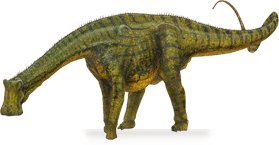
Pronunciation: ruh-BASH-ee-SOR-uh-day
Author: Jose Bonaparte
Year: 1997
Meaning: Aït Rebbach lizards (see etymology)
Locomotion: Quadrupedal
Synonyms: None known
[Salgado, 2004]Definition
All diplodocoids more closely related to Rebbachisaurus garasbae than to Diplodocus longus.
About
Rebbachisauridae appears in the Early Cretaceous and carries the torch as the final surviving branch of Diplodocoidea, overlapping only briefly with the last of the dicraeosaurids. The group's earliest representatives arise in South America and Africa, where they establish the vertebral architecture that distinguishes the clade: extreme fossae and intricate laminae — a lattice of hollows and struts formed as air-sacs from the sauropod breathing system invaded the spinal column. As ecosystems shift, rebbachisaurids carve out a distinct ecological role within the herbivore guild as the archetype of a ground-level browser.
Rebbachisaurids are medium-bodied sauropods, characterised by light construction, gracile limbs, relatively short necks, and flexible tails that lack the extreme whiplash specialisation of their flagilicaudatan cousins. Their skulls are distinctive—elongate, lightly built, and equipped with specialised low-browsing dentitions, none more so than Nigersaurus, which evolved a vacuum-cleaner-like muzzle with banks of rapidly replaced teeth sitting only at the front of the jaws. As a whole, rebbachisaurids embrace efficiency and economy over the bulk and heft typical of the competing macronarians, representing a body plan far removed from other diplodocoids.
By the Cenomanian–Turonian, long before the close of the Cretaceous, rebbachisaurids vanish and the diplodocoid lineage ends. Their specialisations tied them to a selective-browsing realm that shrank as mid-Cretaceous ecosystems reorganised and the structure of plant communities shifted, leaving them with no evolutionary escape route. Yet their skull design was not inherently doomed: after an eight-million-year hiatus it reappeared, attached to the shortened necks of certain titanosaurs—the flexible generalists, hard-wired to ride out ecological turbulence, that were flourishing worldwide. This was not mimicry, for there were no rebbachisaurids left to mimic; it was convergence on a solution suited to a feeding niche that had reopened as ecosystems stabilised without them.
Click here to view Dinochecker's A-Z list of Rebbachiosaurids.
Etymology
Rebbachisauridae is derived from "Aït Rebbach" (the Berber tribe of Morocco, on whose territory the fossils of the first member and anchor—Rebbachisaurus—were found), the Greek "sauros" (lizard), and the Latin "-idae" (family).
Relationships
References
• Bonaparte JF (1997) "Rayososaurus agrioensis Bonaparte 1995". Ameghiniana, 34(1): 116.
• Harris JD ans Dodson P (2004) "A new diplodocoid sauropod dinosaur from the Upper Jurassic Morrison Formation of Montana, USA". Acta Palaeontologica Polonica, 49(2): 197-210.
• Upchurch P, Barrett PM and Dodson P (2004) "Sauropoda". Page 259-322 in Weishampel, Dodson and Osmolska (eds.) "The Dinosauria: Second Edition".
• Salgado L, Garrido A, Cocca SE and Cocca JR (2004) "Lower Cretaceous rebbachisaurid sauropods from Cerro Aguada del León (Lohan Cura Formation), Neuquén province, northwestern Patagonia, Argentina". Journal of Vertebrate Paleontology, 24(4): 903-912. DOI: 10.1671/0272-4634(2004)024[0903:LCRSFC]2.0.CO;2.
• Wilson JA and Sereno PC (2005) "Structure and Evolution of a Sauropod Tooth Battery". Page 157–177 in Curry Rogers and Wilson (eds.) "The sauropods: evolution and paleobiology".
Sereno PC, Wilson JA, Witmer LM, Whitlock JA, Maga A, Ide O and Rowe TA (2007) "Structural Extremes in a Cretaceous Dinosaur". PLOS ONE, 2(11): e1230. DOI: 10.1371/journal.pone.0001230.
• Apesteguía S, Gallina PA and Haluza A (2010) "Not just a pretty face: anatomical peculiarities in the postcranium of Rebbachisaurids (Sauropoda: Diplodocoidea)". Historical Biology, 22(1-3): 165-174. DOI: 10.1080/08912960903411580.
• Whitlock JA (2011) "A phylogenetic analysis of Diplodocoidea (Saurischia: Sauropoda)". Zoological Journal of the Linnean Society, 161; 872–915.
• Salgado L, Gallina PA, Lerzo LN and Canudo JI (2022) "Highly Specialized Diplodocoids: The Rebbachisauridae". Page 165–208 in Otero, Carballido and Pol (eds.) "South American Sauropodomorph Dinosaurs: Record, Diversity and Evolution".
• Filippi LS, Juárez Valieri RD, Gallina PA, Méndez AH, Gianechini FA and Garrido AC (2023) "A rebbachisaurid-mimicking titanosaur and evidence of a Late Cretaceous faunal disturbance event in South-West Gondwana". Cretaceous Research: 105754. DOI: 10.1016/j.cretres.2023.105754.
• Windholz GJ, Porfiri JD, Dos Santos D, Bellardini F and Wedel MJ (2024) "A well-preserved vertebra provides new insights into rebbachisaurid sauropod caudal anatomical and pneumatic features".  Acta Palaeontologica Polonica, 69(1): 39-47 DOI: 10.4202/app.01104.2023.
• Bellardini F, Filippi LS, Carballido JL, Garrido AC and Baiano MA (2025) "Side by side with titans: A new rebbachisaurid dinosaur from the Huincul Formation (upper Cenomanian) of Patagonia, Argentina". Cretaceous Research, 176: 106188. DOI: 10.1016/j.cretres.2025.106188.
Acta Palaeontologica Polonica, 69(1): 39-47 DOI: 10.4202/app.01104.2023.
• Bellardini F, Filippi LS, Carballido JL, Garrido AC and Baiano MA (2025) "Side by side with titans: A new rebbachisaurid dinosaur from the Huincul Formation (upper Cenomanian) of Patagonia, Argentina". Cretaceous Research, 176: 106188. DOI: 10.1016/j.cretres.2025.106188.
Acta Palaeontologica Polonica, 69(1): 39-47 DOI: 10.4202/app.01104.2023.
• Bellardini F, Filippi LS, Carballido JL, Garrido AC and Baiano MA (2025) "Side by side with titans: A new rebbachisaurid dinosaur from the Huincul Formation (upper Cenomanian) of Patagonia, Argentina". Cretaceous Research, 176: 106188. DOI: 10.1016/j.cretres.2025.106188.