









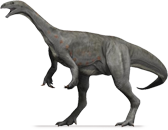
Pronunciation: ah-SIGH-lo-SOR-US
Meaning: Unharmed lizard
Author/s: Galton (2007)
Synonyms: None known
First Discovery: Bristol, England
Acta Ordinal: #177
Asylosaurus yalensis
(Unharmed lizard from Yale)Etymology
Asylosaurus is derived from the Greek "asylos" (unharmed, safe from violence) and "sauros" (lizard).
The species epithet, yalensis, is latinised and means "from Yale", referring to Yale College (now University). Although not actually from Yale, its remains were taken there by O.C. Marsh, who engaged in fossil exchanges with the Bristol Institution Museum and its curator Edward Wilson between 1888 and 1890. As a result, it dodged the Luftwaffe as they bombed the buggery out of Bristol and its fossils in the
1940s, during WWII. To honour its fortuitous survival, palaeontologist Peter Galton chose the name Asylosaurus—"unharmed lizard"—in 2007.
Discovery
The remains of Asylosaurus were discovered by workmen in the Magnesian Conglomerate Formation at the "Quarry Steps" limestone quarry of Durdham Down, Clifton village, England, in 1834. At this point in time, Clifton was part of Gloucestershire, but it was incorporated into the city of Bristol in the 1930s.
The holotype (YPM 2195) is a partial skeleton including back vertebrae, ribs, gastralia, elements of the shoulder girdle, both upper arms, a partial forearm, and a hand. Additional bones from the neck, tail, pelvis, and limbs that may represent the same individual have also been referred to Asylosaurus.


