




Pronunciation: SAY-gee-SOR-us
Meaning: Segi (Canyon) lizard
Author/s: Camp (1936)
Synonyms: None known
First Discovery: Tsegi Canyon, Arizona
Acta Ordinal: #180
Segisaurus halli
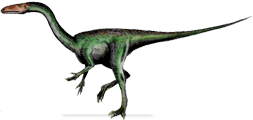
When Max Littlesalt, a Navajo Indian cattle farmer, discovered Segisaurus halli in Arizona's Tsegi Canyon in 1933, he knew right away that it wasn't a part of his herd. It was fossilised for a start and didn't have a head, and it was sat in a brooding hen position that even the most supple of cows would struggle to mimic.
Named in 1936 by palaeontologist Charles Lewis Camp, Segisaurus was initially thought to have solid bones. But, after gathering dust for the best part of fifty years, experts from the Journal of Vertebrate Paleontology performed a long overdue review and showed that they were, in fact, hollow (the bones, that is), just like those of other theropods.
Because only a single subadult Segisaurus has been found, it's not exactly clear how much more growing this cousin of Procompsognathus had left to do. The general opinion is that it won't have grown much bigger than the goose-sized holotype, so it was never going to be an apex predator, but we'll bet it put the fear of God into Mid-Jurassic insects!
Named in 1936 by palaeontologist Charles Lewis Camp, Segisaurus was initially thought to have solid bones. But, after gathering dust for the best part of fifty years, experts from the Journal of Vertebrate Paleontology performed a long overdue review and showed that they were, in fact, hollow (the bones, that is), just like those of other theropods.
Because only a single subadult Segisaurus has been found, it's not exactly clear how much more growing this cousin of Procompsognathus had left to do. The general opinion is that it won't have grown much bigger than the goose-sized holotype, so it was never going to be an apex predator, but we'll bet it put the fear of God into Mid-Jurassic insects!
Hall's Rock Canyon lizardEtymology
Segisaurus is derived from the Navajo Indian "tsegi" (meaning Rock Canyon) and the Greek "sauros" (lizard). The species epithet, halli, honors Ansel Franklin Hall, ex-chief of the National Park education and forestry division and director of Rainbow Bridge Monument Valley expeditions in 1933-34.
Discovery
The remains of Segisaurus were discovered in the Navajo Sandstone formation, a mile north of Keet Seel ruin in Segi Canyon, Coconino County, Arizona, by Max Littlesalt on July 27th, 1933. The holotype (UCMP 32101) is a partial skeleton including bits of limbs, pelvis and vertebrae.


