









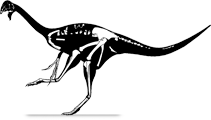
Pronunciation: woo-la-tuh-long
Meaning: Wulate dragon
Author/s: Xu Xing (2013)
Synonyms: None known
First Discovery: Linhe, China
Acta Ordinal: #855
Wulatelong gobiensis
(Wulate dragon from the Gobi)Etymology
Wulatelong is derived from "Wulatehouqi" (the area in which the holotype was found) and the Chinese Pinyin "long" (dragon).
The species epithet (or specific name), gobiensis, means "from the Gobi" in Latin.
Discovery
The remains of Wulatelong were discovered in the Wulansuhai Formation at "The Gate" Locality, near the Village of Bayan Mandahu, Wulatehouqi, Linhe District, Inner Mongolia, China, in 2009.
The holotype (IVPP V 18409) is a partial and badly-weathered skeleton with some skull material.
Behind a large specimen sat atop a nest of eggs that may, or may not, be Oviraptor philoceratops (IVPP V9608) and Machairasaurus leptonychus (IVPP V15979 and IVPP V15980), Wulatelong is the third oviraptorid species known from the Bayan Mandahu area.
Preparators
Xiang Lishi and Ding Xiaoqing.


