









Pronunciation: khahng-cho-SOR-us
Meaning: Changzhou lizard
Author/s: Xu (2026)
Synonyms: None known
First Discovery: Liaoning Province, China
Acta Ordinal: #1244
Changzhousaurus sinensis
Discovered near Lamadong in western Liaoning and described in 2026, Changzhousaurus sinensis represents one of the smallest and most visually elaborate pennaraptoran dinosaurs known from the Jehol Biota—an Early Cretaceous ecosystem that flourished across northeastern China between roughly 133 and 120 million years ago.
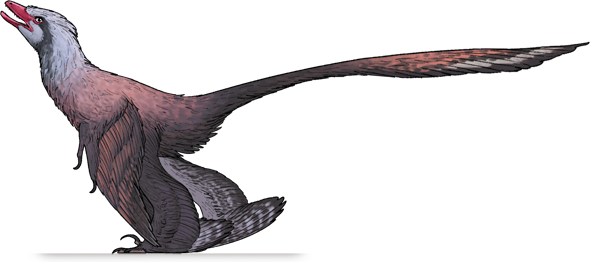
The holotype preserves a nearly complete skeleton with extensive plumage, revealing a four-winged animal only about 34-cm long, its body framed by large forelimb wings, shorter hindlimb wings, and an extraordinary spray of sixteen extremely elongated tail plumes. These tail feathers, each several times longer than the thighbone, form a dramatic fan reminiscent of a peacock's ornamental train, and were likewise most likely for a fancy dan display rather than flight.
Anatomically, Changzhousaurus blends features seen in early "raptors", the first birds, and the in-between anchiornithids, highlighting the experimental diversity of feathered theropods in the Early Cretaceous. Its combination of aerodynamic surfaces and ostentatious ornamental feathers is just one of many pennaraptoran solutions for signaling and maneuverability.
The holotype preserves a nearly complete skeleton with extensive plumage, revealing a four-winged animal only about 34-cm long, its body framed by large forelimb wings, shorter hindlimb wings, and an extraordinary spray of sixteen extremely elongated tail plumes. These tail feathers, each several times longer than the thighbone, form a dramatic fan reminiscent of a peacock's ornamental train, and were likewise most likely for a fancy dan display rather than flight.
Anatomically, Changzhousaurus blends features seen in early "raptors", the first birds, and the in-between anchiornithids, highlighting the experimental diversity of feathered theropods in the Early Cretaceous. Its combination of aerodynamic surfaces and ostentatious ornamental feathers is just one of many pennaraptoran solutions for signaling and maneuverability.
(Changzhou Lizard from China)Etymology
Changzhousaurus is derived from "Changzhou" (a city in Jiangsu Province, China, in recognition of their Municipal Government for supporting dinosaur palaeontology and promoting popular science) and the Greek "sauros" (lizard). The species epithet, sinensis (sih-NEN-sis), is derived from the Latin "sinae" (China) and "-ensis" (from). ZooBank registry: urn:lsid:zoobank.org:pub:DDDBF69B-C9BD-429B-9C71-6CA22924CD0C.
Discovery
The remains of Changzhousaurus were discovered in the Jiufotang Formation at Lamadong, Jianchang, western Liaoning Province, China.
The holotype, housed at the Lande Museum of Natural History, Tangshan, Hebei Province, China, is a nearly complete skeleton with associated plumage preserved on a slab (2026A) and a counter slab (2026B). Casts of both slab and counter slab are housed at the Institute of Vertebrate Paleontology and Paleoanthropology, Chinese Academy of Sciences (catalogued as IVPP FV2204A and 2204B).
Preparators
Ding Xiaoqing.


