




Pronunciation: bay-SHAN-long
Meaning: Beishan (Northern Mountain) dragon
Author/s: Makovicky et al. (2009)
Synonyms: None known
First Discovery: Gansu, China
Acta Ordinal: #706
Beishanlong grandis
At seven meters in length, Beishanlong is one of the largest "ostrich-mimics" (ornithomimosaurs), rivalling Mongolia's Gallimimus in size. Yet the closed sutures and bone fusion that arrive with maturity were lacking, indicating that the holotype was still growing at the time of death.
To assess the individual's age, palaeontologists took a slice of calfbone to count the LAGs (lines of arrested growth), just like counting growth rings on trees, but with polarized and reflected light microscopy. Alas, what they discovered is that Beishanlong was a young adult and, as such, didn't have a lot of growing left to do.
Compared to its Late Cretaceous kin, Beishanlong was more robust with powerfully built forelimbs but lacked their extremely elongated hands, feet and claws. It also lacked an arctometatarsus, whereby the middle of three metatarsals (the bones that join the toes to the ankle) is "pinched" by the flanking two. In ostrich mimics, this feature is generally regarded as an adaptation for swift running, so swift running Beishanlong was not. However, its middle foot bone is wedge-shaped, tapering towards the top and contributes least to the ankle joint, suggesting it was an intermediate step in the evolution of the specialized ornithomimosaurid foot, and the full-on "pinching" was on its way.
The ornithomimosaur Beishanlong lived in the same place at the same time as the therizinosaur Suzhousaurus and the oviraptorosaur Gigantoraptor, which provides evidence for the parallel evolution of gigantism in three separate lineages of beaked herbivorous theropods, who were all bigger than the biggest carnivorous dinosaur in their ecosystem.
Compared to its Late Cretaceous kin, Beishanlong was more robust with powerfully built forelimbs but lacked their extremely elongated hands, feet and claws. It also lacked an arctometatarsus, whereby the middle of three metatarsals (the bones that join the toes to the ankle) is "pinched" by the flanking two. In ostrich mimics, this feature is generally regarded as an adaptation for swift running, so swift running Beishanlong was not. However, its middle foot bone is wedge-shaped, tapering towards the top and contributes least to the ankle joint, suggesting it was an intermediate step in the evolution of the specialized ornithomimosaurid foot, and the full-on "pinching" was on its way.
The ornithomimosaur Beishanlong lived in the same place at the same time as the therizinosaur Suzhousaurus and the oviraptorosaur Gigantoraptor, which provides evidence for the parallel evolution of gigantism in three separate lineages of beaked herbivorous theropods, who were all bigger than the biggest carnivorous dinosaur in their ecosystem.
(Large Bei Shan Dragon)Etymology
Beishanlong is derived from the Mandarin "Bei Shan" (Northern Mountain) and "long" (dragon).The species epithet, grandis (gran-DIS), means "large" in Latin.
Discovery
Beishanlong was discovered at "White Ghost Castle" in the Xiagou Formation, Xinminpu Group, Yujingzi Basin, northern Gansu, China, by an international team of researchers from China and the United States during 2006 and 2007 field seasons.
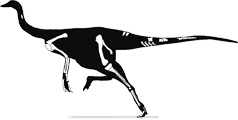
The holotype, FRDC-GS GJ (06) 01-18, is a partial skeleton, including 2 bones from the left shoulder girdle, a hip bone (left ischium), 8 tail vertebrae, 2 spines and four chevrons, a left thigh, a partial right leg and foot, and a partial left arm and hand.
Referred material includes FRDC-GS JB(07)01-01—a pair of isolated pubes fouind close to the holotype, and FRDC-GS GJ (unnumbered)—hindlimb elements of a large specimen, found in the overlying "red beds". All three specimens are currently housed at the Fossil Research and Development Center (FRDC), Third Geology and Mineral Resources Exploration Academy, Gansu Provincial Bureau of Geo-Exploration and Mineral Development in Lanzhou, China.
A gigantic ornithomimosaur foot from Mazongshan in Gansu that Shapiro described in 2003 might belong to Beishanlong. The latter was found by a joint expedition of the Carnegie Museum of Natural History, the University of Pennsylvania, and the Institute of Vertebrate Paleontology and Paleoanthropology (IVPP) in 1999.


