









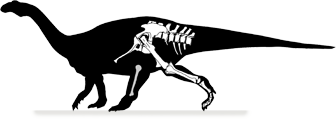
Pronunciation: tur-bin-jo-sor-us
Meaning: Tübingen lizard
Author/s: Fernandez and Werneburg (2022)
Synonyms: None known
First Discovery: Tübingen, Germany
Acta Ordinal: #1117
Tuebingosaurus maierfritzorum
(Tübingen lizard)Etymology
Tuebingosaurus is derived from "Tübingen" (for the city of Tübingen) and the Greek "sauros" (lizard).
The species epithet, maierfritzorum, honours Uwe Fritz and
Wolfgang Maier. The former is the editor-in-chief of the journal Vertebrate Zoology, and, in his journal, he facilitated the Festschrift (a volume compiled as a tribute, especially to a scholar) edited by Ingmar Werneburg and Irina Ruf in honour of Wolfgang Maier. The latter was a professor of evolutionary zoology in Tübingen from 1987 to 2007, and the Festschrift was published on the occasion of his 80th birthday in 2022.
Zoobank registry: urn:lsid:zoobank.org:act:B60C4F76-5CFA-4E9A-8745-E98E1CD6D8FC.
Discovery
The remains of Tuebingosaurus were discovered at "Obere Mühle" in the lower dinosaur bed of the Trossingen Formation, Tübingen, Swabian Alb, Germany, in 1922. The holotype (GPIT-PV-30787, but historically referred to as 'GPIT IV') consists of a complete pelvis
(three sacral vertebrae, two ilia, two pubes, two ischia),
five tail vertebrae, four chevrons, left thigh, left shin, both calfbones, left ankle and heel, a metatarsal and two toes. It was referred to Plateosaurus longiceps (Jaekel, 1913) by Galton in 2001.


