Pronunciation: PLAT-ee-oh-SOR-ree-uh
Author: Gustav Tornier
Year: 1913
Meaning: Broad lizards (see etymology)
Locomotion: Both bipedal and quadrupedal (2 and 4 legs)
Synonyms: None known
[Sereno, 2005]Definition
The least inclusive clade containing Plateosaurus engelhardti and Massospondylus carinatus, but not Saltasaurus loricatus.
About
Plateosauria emerges in the Late Triassic as the first great flourishing of sauropodomorph dinosaurs, a radiation that transforms the group from lightly built omnivores into large-bodied herbivores. Defined by the shared ancestry of Plateosaurus and Massospondylus, this clade gathers the forms that establish the basic architecture of the long-necked lineage. Their emergence coincides with a world in flux: forests expanding, herbivore guilds reshuffling, and ecological roles once held by rhynchosaurs and dicynodonts opening to new claimants.
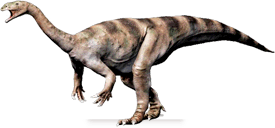
Plateosaurians are the "prosauropods" of older literature, but the name masks their ingenuity. Their long necks extend browsing reach; their hands remain capable of grasping; and their powerful hindlimbs support a primarily bipedal stance, with the ability to drop into quadrupedal stability when feeding or moving slowly. Their skulls retain the light construction of early dinosaurs, but their teeth and jaws show a clear commitment to plant-processing. They are not giants, but they are the first to treat size as a strategy— deepening their torsos, expanding their digestive capacity, and exploring the anatomical possibilities of sustained herbivory before gigantism made those choices irreversible.
Rather than primitive waypoints on the road to sauropods, plateosaurians are active experimenters. They test combinations of posture, feeding mechanics, and body proportions that later lineages will refine, discard, or magnify. Many plateosaurians disappear at the Triassic–Jurassic boundary, but their evolutionary legacy is far-reaching: Plateosauria forms the rootstock from which Massopoda, Sauropodiformes, and, ultimately, Sauropoda arise.
Click here to view Dinochecker's A-Z list of plateosaurians.
Etymology
Although shrouded in mystery because Tornier didn't provide a meaning for the name of group anchor Plateosaurus, Plataeosauria is probably derived from the Greek "plateos" (broad, wide, bulky, in reference to its robust limb bones) and "sauros" (lizard), and the Latin "-ia" (plural).
Relationships
References
• Tornier G (1913) "Reptilia (Paläontologie)". Handwörterbuch Naturwissenschaften, 8: 337-376
• Galton P (2001) "The prosauropod dinosaur Plateosaurus MEYER, 1837 (Saurischia: Sauropodomorpha; Upper Triassic). II. Notes on the referred species". Revue de Paleobiologie, 20(2): 435-502
• Galton PM and Upchurch P (2004) "Prosauropoda". Page 232–258 in Weishampel, Dodson and Osmólska (Eds.) "The Dinosauria: Second Edition".
• Otero A and De Fabrègues CP (2022) "Non-sauropodiform Plateosaurians: Milestones Through the "Prosauropod" Bauplan". Page 51–92 in "South American Sauropodomorph Dinosaurs".