Pronunciation: mas-oh-spon-DI-luh-day
Author: Friedrich von Huene
Year: 1914
Meaning: Long vertebrae family (see etymology)
Locomotion: Bipedal (two legs)
Synonyms: None known
Definition[Sereno, 2005]
The most inclusive clade containing Massospondylus carinatus but not Plateosaurus engelhardti or Saltasaurus loricatus.
About
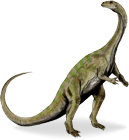
Massospondylidae emerged in the Late Triassic as the lineage that never slows its stride. While many of their kin drifted toward bulk, reinforced limbs, and the early architecture of sauropodiform mass, these animals hold fast to agility. Anchored by Massospondylus and its close relatives, they represented a parallel evolutionary gamble: what if sauropodomorphs stayed quick, alert, and versatile in a world beginning to reward size?Their skeletons tell the story of creatures optimized for flexibility. The neck stretched; the skull remained lightly built; the limbs stayed gracile enough for confident, habitual bipedalism. Their hands retained a grasping finesse lost in heavier cousins, with some species showing hints of omnivory or selective browsing. They moved with a blend of speed and control — among the last sauropodomorphs to pair reach with delicacy before the lineage’s center of gravity shifts decisively toward mass.
For a time, this strategy thrived. Through the Late Triassic and into the earliest Jurassic, massospondylids occupied a niche on nearly every southern continent — Asia, Africa, North America, South America, and even Antarctica — where lightness, maneuverability, and dietary flexibility offered real advantages. But as the Early Jurassic progressed, the ecological stage tilted. Larger, more robust sauropodiforms rose; landscapes stabilized after the end-Triassic disruptions; and the window that favoured nimbleness narrowed. By the mid–Early Jurassic, Massospondylidae faded from the fossil record — a successful lineage whose ecological moment had passed.
Massospondylus aside (it's a shoo-in as the group anchor and type specimen) the likes of Adeopapposaurus, Coloradisaurus, Glacialisaurus, Leyesaurus, Lufengosaurus and Pradhania, and possibly Mussaurus and Xixiposaurus, seem to belong here. Sarahsaurus, Seitaad and Ignavusaurus, who were tentatively assigned to Massospondylidae initially, were recently booted out, but they continue to lurk on the outskirts.
Click here to search Dinochecker for massospondylids.
Etymology
Massospondylidae is derived from the Greek "masson" (longer) and "spondylos"' (vertebra), and the Latin "-idae" (family), and is named for the group anchor; Massospondylus.
Relationships
References
• Yates AM (2003) "Species taxonomy of the sauropodomorph dinosaurs from the Löwenstein Formation (Norian, Late Triassic) of Germany". Palaeontology, 46(2):317-337. DOI: 10.1111/j.0031-0239.2003.00301.x.
• Apaldetti C, Martinez RN, Alcober OA and Pol D (2011) "A New Basal Sauropodomorph (Dinosauria: Saurischia) from Quebrada del Barro Formation (Marayes-El Carrizal Basin), Northwestern Argentina". PLoS ONE, 6(11): e26964. DOI: 10.1371/journal.pone.0026964.
• Hellert SM (2012) "A New Basal Sauropodomorph from The Early Jurassic Hanson Formation of Antarctica". Geological Society of America Abstracts with Programs, 44(5) .
• MÜller RT (2019) "Craniomandibular osteology of Macrocollum itaquii (Dinosauria: Sauropodomorpha) from the Late Triassic of southern Brazil". Journal of Systematic Palaeontology, 18(10): 805-841. DOI: 10.1080/14772019.2019.1683902.
• Rauhut OWM, Holwerda FM and Furrer H (2020) "A derived sauropodiform dinosaur and other sauropodomorph material from the Late Triassic of Canton Schaffhausen, Switzerland". Swiss Journal of Geosciences, 113(1): 8. DOI: 10.1186/s00015-020-00360-8.