Pronunciation: kaht-uh-doh-kus
Meaning: Small Diplodocus
Author/s: Tschopp and Mateus (2012)
Synonyms: None known
First Discovery: Wyoming, USA
Acta Ordinal: #840
Kaatedocus siberi
Despite Henry Galiano's much derided 2010 attempt to rid the fossil register of every known Morrison Formation diplodocid barring Amphicoelias altus and their own ridiculously-named Amphicoelias brontodiplodocus ("both sides hollow thunder double beam"), Kaatedocus is a newly-named diplodocid... from the Morrison Formation.
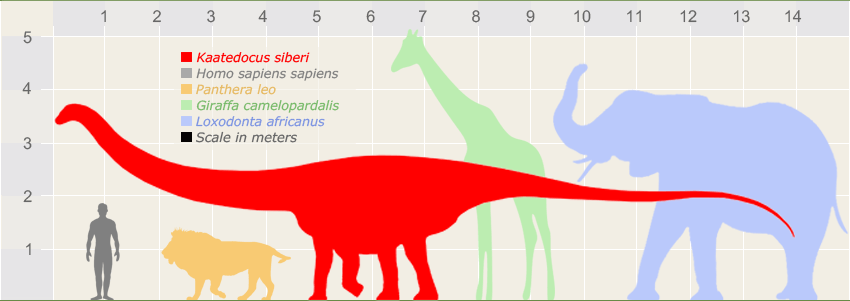
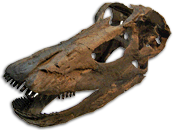
Coined for Barnum Brown's left-overs at Howe Quarry in 1990 and long-thought to represent a juvenile specimen of either Diplodocus (Ayer 2000) or Barosaurus (Michelis 2004), Kaatedocus is small but sports numerous features in common with several much larger Morrison sauropods. Its skull is remarkably similar to the skull of Diplodocus, the only diplodocid for which a juvenile skull is known, while the joint that connects the skull to the spine (atlas-axis) is very Apatosaurus and Suuwassea-like. Tschopp and Mateus pin-pointed a handful of unique characteristics within its longer-than-high but higher-than-wide neck verts in 2012, but didn't compare them to suspected Diplodocus specimens from the same site because those have yet to be fully described. However, a 2013 abstract did report several braincases of different form and structure from Howe Quarry that were CT scanned and rendered in 3-d, which suggests the presence of at least two types of diplodocid diplodocine dinosaur.
Though it could conceivably be a dwarf, the diddy-for-a-sauropod Kaatedocus is still puzzling palaeontologists. Some experts are asking why this particular critter is worthy of its own name when it may simply represent a juvenile specimen of one of the area's already copious adult diplodocids, though presumably at least one of them had the chance to call out the authors during the obligatory peer-review process and refrained. Science is all about falsifying hypotheses, and we expect an almighty pen-fight any time now.
Coined for Barnum Brown's left-overs at Howe Quarry in 1990 and long-thought to represent a juvenile specimen of either Diplodocus (Ayer 2000) or Barosaurus (Michelis 2004), Kaatedocus is small but sports numerous features in common with several much larger Morrison sauropods. Its skull is remarkably similar to the skull of Diplodocus, the only diplodocid for which a juvenile skull is known, while the joint that connects the skull to the spine (atlas-axis) is very Apatosaurus and Suuwassea-like. Tschopp and Mateus pin-pointed a handful of unique characteristics within its longer-than-high but higher-than-wide neck verts in 2012, but didn't compare them to suspected Diplodocus specimens from the same site because those have yet to be fully described. However, a 2013 abstract did report several braincases of different form and structure from Howe Quarry that were CT scanned and rendered in 3-d, which suggests the presence of at least two types of diplodocid diplodocine dinosaur.
Though it could conceivably be a dwarf, the diddy-for-a-sauropod Kaatedocus is still puzzling palaeontologists. Some experts are asking why this particular critter is worthy of its own name when it may simply represent a juvenile specimen of one of the area's already copious adult diplodocids, though presumably at least one of them had the chance to call out the authors during the obligatory peer-review process and refrained. Science is all about falsifying hypotheses, and we expect an almighty pen-fight any time now.
(Siber's Small Diplodocus)
Etymology
Kaatedocus is derived from "Kaate" (small, little, tiny) in the language of Crow (Absaroka) - a Native American tribe of northern Wyoming, and the Greek "dokos" (beam), in reference to its modest size and an allusion to the much larger, though closely related, Diplodocus. The species epithet, siberi, is named in honor of Hans-Jakob "Kirby" Siber, director of the Sauriermuseum in Aathal, Switzerland.
ZooBank registry: urn:lsid:zoobank.org:act:E559FA2A-67AF-4A8E-818F-A3E6999CC3FC.
Discovery
The remains of Kaatedocus were discovered at Howe Quarry in the Morrison Formation, Shell, Big Horn County, Wyoming, in 1990-91. The quarry was first worked in 1930-31 by the American Museum of Natural History's Barnum Brown who unearthed some 3000 bones, many of which were destroyed in a 1940s fire.
Brown planned to return a couple of years later having secured financial backing from the Sinclair Oil Corporation, but pulled the plug when quarry owner Barker Howe demanded handsome payment for all finds, and tons of unwanted sauropod remains simply rotted away having been stored in an old chicken coop! Swiss paleontologists led by Siber re-opened the quarry in 1990 and were overjoyed to find that hundreds of bones remained in the ground. The holotype (SMA 0004) is a series of neck vertebrae and a partial skull.
A beaked giant
In 2026, Gobbo and colleagues studied the small openings for nerves and blood vessels on the front of a Kaatedocus skull and compared them with living animals whose facial tissues are well understood. They found that the pattern matches modern birds more than crocodiles, suggesting that Kaatedocus carried a broad, tough, beak-like keratin covering—an "odontoscutum"—over the snout and lower jaw. This sheath likely overlapped the teeth, protecting them from mechanical wear and tear during feeding, and helping the animal grasp and strip vegetation.