
KULINDADROMEUS
a plant-eating neornithischian dinosaur from the Late Jurassic of Siberia.
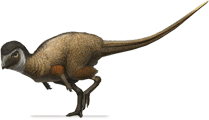
Pronunciation: KOO-lin-dah-DRO-mee-us
Meaning: Kulinda runner
Author/s: Godefroit
et al. (
2014)
Synonyms: See
below
First Discovery: Siberia, Russia
Acta Ordinal: #887
Kulindadromeus zabaikalicus
(Kulinda runner from Zabaykalsky Krai)Etymology
Kulindadromeus is derived from "Kulinda" (for the locality in which it was discovered) and the Greek "dromeus" (runner).
The
species epithet,
zabaikalicus (ZAH-bike-kal-ik-kuss), is derived from "Zabaykalsky Krai" (the region in which the locality is located).
ZooBank registry:
urn:lsid:zoobank.org:act:343881D7-FC69-4117-891F-CB0D411D25FF.
Kulindapteryx ukureica (Alifanov and Saveliev, 2014)
Daurosaurus olovus (Alifanov and Saveliev, 2014)
Lepidocheirosaurus natatilis? (Alifanov and Saveliev, 2015)
Discovery
The first remains of
Kulindadromeus were discovered in Konservat-Lagerstätte of the Ukureisk formation at the Kulinda locality, within the Olov Depression, Chernyshevsky District, near Chernyshevsk Village, 220 km to the east of Chita city in what is now Zabaykalsky Krai (formerly Chitinskaya Oblast or Chita Region), Transbaikal region, southeastern Siberia, Russia, by Sofia M. Sinitsa, during an Institute of Natural Resources, Ecology and Cryology, Siberian Branch of the Russian
Academy of Sciences (INREC) expedition in 2010.
The Ukureisk formation is variously listed as Ukureiskaya, Ukureyskaya, Ukurey.
The
holotype (INREC K3/109) is a partial skull, plucked from hundreds of disarticulated skeletons across two bone beds.
Estimations
Timeline:
Era: Mesozoic
Epoch: Middle Jurassic
Stage: Bathonian
Age range: 168-166 mya
Stats:
Est. max. length: 1.5 meters
Est. max. hip height: ?
Est. max. weight: 5 Kg
Diet: Herbivore
Kulindadromeus
zabaikalicus
References
• Godefroit P, Sinitsa S, Dhouailly D and Yuri Bolotsky Y (2013) "Feather-like structures and scales in a Jurassic neornithischian dinosaur from Siberia".
Program and Abstracts of the 73rd Meeting of the Society of Vertebrate Paleontology, Society of Vertebrate Paleontology.
• Godefroit P, Sinitsa SM, Dhouailly D, Bolotsky YL, Sizov AV, McNamara ME, Benton MJ and Spagna P (2014) "
A Jurassic ornithischian dinosaur from Siberia with both feathers and scales".
Science, 345(6195): 451-455. DOI: 10.1126/science.1253351.
• Lingham-Soliar T (2014) Comment on "
A Jurassic ornithischian dinosaur from Siberia with both feathers and scales".
Science,
346(6208): 434. [Response from
Godefroit et al.]
• Alifanov VR and Saveliev SV (2014) "Two new ornithischian dinosaurs (Hypsilophodontia, Ornithopoda) from the Late Jurassic of Russia".
In Russian: Paleontologicheskii Zhurnal. 4: 72-82. English translation: Paleontological Journal. 48(4): 414-425. DOI: 10.1134/S0031030114040029. [Coins Kulindapteryx and Daurosaurus].
• Creisler B (5th July, 2014) "
Re: Kulindapteryx and Daurosaurus, new hypsilophodont ornithopods from Upper Jurassic of Siberia, Russia".
Message to the Dinosaur Mailing List.
• Alifanov VR and Saveliev SV (2015) "
The Most Ancient Ornithomimosaur (Theropoda, Dinosauria), with Cover Imprints from the Upper Jurassic of Russia".
Paleontological Journal 49(6): 636-650. DOI: 10.1134/S0031030115060039. [Coins Lepidocheirosaurus natatilis].
• Paul GS (2016) "
The Princeton Field Guide to Dinosaurs".
• Cincotta A, Pestchevitskaya EB, Sinitsa SM, Markevich VS, Debaille V, Reshetova SA, Mashchuk IM, Frolov AO, Gerdes A, Yans J and Godefroit P (2019) "The rise of feathered dinosaurs:
Kulindadromeus zabaikalicus, the oldest dinosaur with 'feather-like tuft' structures".
PeerJ. 7: e6239. DOI: 10.7717/peerj.6239.
• Godefroit P, Sinitsa SM, Cincotta A, McNamara ME, Reshetova SA and Dhouailly D
(2020) "Integumentary Structures in
Kulindadromeus zabaikalicus, a Basal Neornithischian Dinosaur from the Jurassic of Siberia". In Foth and Rauhut (eds.) "The Evolution of Feathers: From Their Origin to the Present".
Fascinating Life Sciences. Cham: Springer International Publishing. DOI: 10.1007/978-3-030-27223-4.
Time stands still for no man, and research is ongoing. If you spot an error, or want to expand, edit or add a dinosaur, please use
this form. Go
here to contribute to our FAQ.
All dinos are GM free, and no herbivores were eaten during site construction!
To cite this page:
Atkinson, L.
"
KULINDADROMEUS :: from DinoChecker's dinosaur archive".
‹
http://www.dinochecker.com/dinosaurs/KULINDADROMEUS›. Web access: 15th Oct 2026.









