









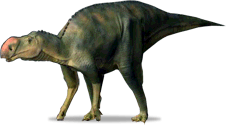
Pronunciation: la-ti-RIEN-us
Meaning: Broad Nose
Author/s: Prieto-Márquez et al. (2012)
Synonyms: None known
First Discovery: Coahuila, Mexico
Acta Ordinal: #838
Latirhinus uitstlani
Previously known as "the Sabinas saurolophine", Latirhinus is an anagram of Altirhinus, albeit a pretty poor one, but while the former has a broad nose the latter has a high one. We don't know if this was intentional on the authors part, but we do know the fee required to access the official paper is out of our reach and this is the best write-in we could come up with at short notice. On the plus side, according to google DinoChecker is the first site to "big up" Latirhinus without a fee. What do you want for free?
Because of its robust snout, Latirhinus differs from all other hadrosaurids barring Gryposaurus, though Gryposaurus hasn't always been attached to its robust snout, and it hasn't always been known as Gryposaurus either. It was discovered by George Sternberg along the Red Deer River in 1913 but within three years Barnum Brown had snaffled its schnoz to replace the Anatotitan-like flat and ducky one he had previously used to reconstruct Kritosaurus in 1910. The latter then sunk into oblivion until the 1990s when paleontologists realised its remains were rubbish, but we think something is afoot as Prieto-Márquez and chums name-dropped "Kritosaurs" in their short abstract which announced Latirhinus in 2012... twice.
Latirhinus is one of the southernmost saurolophines of North America, and the first dinosaur from the Cerro del Pueblo Formation worthy of its own name (?Chasmosaurus sp and Monoclonius sp are not). It adds to the diversity of saurolophines in the southern Western Interior Basin and its occurrence in northern Mexico is consistent with the apparent predominance of big-nosed hadrosaurids in southern Laramidia during late Campanian times.
Because of its robust snout, Latirhinus differs from all other hadrosaurids barring Gryposaurus, though Gryposaurus hasn't always been attached to its robust snout, and it hasn't always been known as Gryposaurus either. It was discovered by George Sternberg along the Red Deer River in 1913 but within three years Barnum Brown had snaffled its schnoz to replace the Anatotitan-like flat and ducky one he had previously used to reconstruct Kritosaurus in 1910. The latter then sunk into oblivion until the 1990s when paleontologists realised its remains were rubbish, but we think something is afoot as Prieto-Márquez and chums name-dropped "Kritosaurs" in their short abstract which announced Latirhinus in 2012... twice.
Latirhinus is one of the southernmost saurolophines of North America, and the first dinosaur from the Cerro del Pueblo Formation worthy of its own name (?Chasmosaurus sp and Monoclonius sp are not). It adds to the diversity of saurolophines in the southern Western Interior Basin and its occurrence in northern Mexico is consistent with the apparent predominance of big-nosed hadrosaurids in southern Laramidia during late Campanian times.
(Southern broad nose)Etymology
Latirhinus is derived from the Latin "Lati" (broad, wide) and the Greek "rhinus" (nose or snout).
The species epithet, uitstlani, means "southern" in the Náhuatl language of Mexico, which refers to this species' southern occurrence in the Cretaceous landmass of Laramidia. ZooBank registry: urn:lsid:zoobank.org:act:070567AB-F3DA-44FD-ADC5-9D2A0B34C19C.
Discovery
The remains of Latirhinus were discovered in the Cerro del Pueblo Formation, in the ejido (communal land) Presa San Antonio, Parras de la Fuente town, Saltillo, Coahuila, northern Mexico, by a research team from the IGLUNAM (Instituto de Geologia of the Universidad Nacional Autónoma de México) in 1987.
The holotype (IGM 6583) is a fragmentary skeleton including a partial snout, 10 back and 14 tail vertebrae, partial right shoulder girdle, left shoulder blade, both upper arms, both ulnae, a partial hip, both thigh, shin and calf bones, left ankle bones, right metacarpals III and IV, right and left metatarsals III and IV, and various toe bones from the right foot.


