









Pronunciation: nuh-TROW-nuh-SOR-us
Meaning: Natrona County lizard
Author/s: Ulansky (2014)
Synonyms: Stegosaurus longispinus
First Discovery: Wyoming, USA
Acta Ordinal: #906
Natronasaurus longispinus
Despite a plethora of species being assigned to it from North America during the latter part of the nineteenth century, Stegosaurus was eventually trimmed to Stegosaurus armatus from Wyoming's Morrison Formation, plus a couple of others from elsewhere, depending on which expert you follow. However, through all the chopping and changing, one species is almost always overlooked. It is also from the Morrison but differs vastly from Stegosaurus armatus in the features of its armour. Moreover, it's perfectly diagnostic, at least by some accounts, despite a rather unfortunate mishap that mullered its remains.
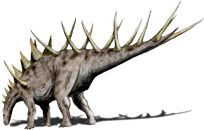
Stegosaurus longispinus found fame in a monograph published by Charles W. Gilmore in 1914 but lasted just six years before its holotype crumbled when the University of Wyoming's water pipes burst. Nevertheless, its "mushroom-headed" vertebrae and legendary tail spikes — the longest being 860mm with the tip missing — lingered in the literature, and most palaeontologists were content to leave it be. Others, however, weren't, and some were still peddling it as an American version of the similarly long-spiked African stegosaur Kentrosaurus as recently as 1993.
In their 2008 review of stegosaurs, Maidment and colleagues finally dismissed Stegosaurus longispinus as dubious, insisting that its "long" spikes were the result of age, growth or gender of the animal that owned them. Furthermore, its holotype was long lost and unavailable for study, which was grounds enough to chalk it off, or so they thought. As it turns out, some remains may have survived, along with fossil casts. But if they were worth anything to science, some honest-to-goodness dinosaur expert would have dealt with them already, right? Well...
Stegosaurus longispinus was severed from Stegosaurus in 2014 by Russian freelancer Roman Ulansky, although he never studied its fossils first-hand, and his actions seem driven solely by the theories of previous authors that science has already rejected. Nevertheless, he bestowed upon it the name Natronasaurus in honour of the Wyoming county where it was found and blessed us with a "description" written entirely in Russian. The name has been registered with Zoobank, so it is official whether we like it or not. But most palaeontologists are far from impressed with Ulansky's serial-self-publishing shenanigans, so it seemed unlikely that Natronasaurus longispinus (or indeed his Amargastegos brevicollus, Andhrasaurus indicus, Chungkingosaurus giganticus, Chungkingosaurus magnus, Ferganastegos callovicus, Eoplophysis vetustus, Saldamosaurus tuvensis, Scelidosaurus arizonensis, Siamodracon altispinus, Sinopeltosaurus (aka Sinopelta) minimus and Wuerhosaurus mongoliensis, which were all named in 2014) would feel their love.
Peter Galton and Kenneth Carpenter took matters into their own hands on February 6th, 2016, and coined Alcovasaurus for the critter that was previously known as Stegosaurus longispinus (and Natronasaurus), citing Ulansky's failure to meet the requirements of the International Code of Zoological Nomenclature, and ditto for 17 (yes, seventeen) other names he had proposed for basal thyreophoran and stegosaurian specimens.
Stegosaurus longispinus found fame in a monograph published by Charles W. Gilmore in 1914 but lasted just six years before its holotype crumbled when the University of Wyoming's water pipes burst. Nevertheless, its "mushroom-headed" vertebrae and legendary tail spikes — the longest being 860mm with the tip missing — lingered in the literature, and most palaeontologists were content to leave it be. Others, however, weren't, and some were still peddling it as an American version of the similarly long-spiked African stegosaur Kentrosaurus as recently as 1993.
In their 2008 review of stegosaurs, Maidment and colleagues finally dismissed Stegosaurus longispinus as dubious, insisting that its "long" spikes were the result of age, growth or gender of the animal that owned them. Furthermore, its holotype was long lost and unavailable for study, which was grounds enough to chalk it off, or so they thought. As it turns out, some remains may have survived, along with fossil casts. But if they were worth anything to science, some honest-to-goodness dinosaur expert would have dealt with them already, right? Well...
Stegosaurus longispinus was severed from Stegosaurus in 2014 by Russian freelancer Roman Ulansky, although he never studied its fossils first-hand, and his actions seem driven solely by the theories of previous authors that science has already rejected. Nevertheless, he bestowed upon it the name Natronasaurus in honour of the Wyoming county where it was found and blessed us with a "description" written entirely in Russian. The name has been registered with Zoobank, so it is official whether we like it or not. But most palaeontologists are far from impressed with Ulansky's serial-self-publishing shenanigans, so it seemed unlikely that Natronasaurus longispinus (or indeed his Amargastegos brevicollus, Andhrasaurus indicus, Chungkingosaurus giganticus, Chungkingosaurus magnus, Ferganastegos callovicus, Eoplophysis vetustus, Saldamosaurus tuvensis, Scelidosaurus arizonensis, Siamodracon altispinus, Sinopeltosaurus (aka Sinopelta) minimus and Wuerhosaurus mongoliensis, which were all named in 2014) would feel their love.
Peter Galton and Kenneth Carpenter took matters into their own hands on February 6th, 2016, and coined Alcovasaurus for the critter that was previously known as Stegosaurus longispinus (and Natronasaurus), citing Ulansky's failure to meet the requirements of the International Code of Zoological Nomenclature, and ditto for 17 (yes, seventeen) other names he had proposed for basal thyreophoran and stegosaurian specimens.
(Long-spined Natrona lizard)Etymology
Natronasaurus is derived from "Natrona" (the U.S. county in which it was found) and the Greek "sauros" (lizard).
The species epithet, longispinus, means "long-spined" in Latin.
ZooBank registry: urn:lsid:zoobank.org:act:129D3DF3-9B7D-44DD-A79D-F325887485AA.
Discovery
The remains of Natronasaurus were discovered in the Morrison Formation, 2.5 kilometers east of Alcova, Natrona County, Wyoming, USA, in 1908 by W.H. Reed and A.C. Dart.The holotype (UW 20503) includes 42 assorted vertebrae, a partial hip, a few ribs, and four tail spikes.


