









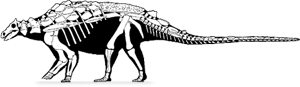
Pronunciation: gahr-GOY-lo-SOR-us
Meaning: Gargoyle lizard
Author/s: Carpenter et al. (1998)
Synonyms: None known
First Discovery: Wyoming, U.S.A.
Acta Ordinal: #433
Gargoyleosaurus parkpinorum
Back in Jurassic times, when sauropods were the dominant herbivores and T.rex was just a twinkle in his ancestor's eye, there was a rustic little fellow, roughly four meters long with a tiny head, heavily fused bones and a seriously tough armour suit.
He wasn't the prettiest, hence the name Gargoyleosaurus, after the hideously ugly stone Gargoyles often found adorning gothic cathedrals. But even at this early stage, he sported the hallmarks typical of ankylosaurs, and provided the platform from which his descendants would evolve into the dinosaurian equivalent of Sherman tanks.
With their fused, fortified noggins, armour plates, low-slung, wide-load build, and no risk of overheating thanks to a snails-pace and complex nasal set-up to keep them cool, ankylosaurs were built to take it. Some were built to give it too, both with their clubbed tails (though the nodosaur ankylosaurids didn't have them) and unfortunate side effects of belly-fulls of constantly fermenting foliage. Such was the genius of their design that they managed to fart their way around every continent barring Africa, and if it wasn't for the K-Pg extinction, the rough-arsed buggers might have lived forever.
With their fused, fortified noggins, armour plates, low-slung, wide-load build, and no risk of overheating thanks to a snails-pace and complex nasal set-up to keep them cool, ankylosaurs were built to take it. Some were built to give it too, both with their clubbed tails (though the nodosaur ankylosaurids didn't have them) and unfortunate side effects of belly-fulls of constantly fermenting foliage. Such was the genius of their design that they managed to fart their way around every continent barring Africa, and if it wasn't for the K-Pg extinction, the rough-arsed buggers might have lived forever.
(Parker and Pinegar's Gargoyle lizard)Etymology
Gargoyleosaurus is derived from "Gargoyle" (for the stone critters found on gothic cathedrals) and the Greek "sauros" (lizard).
The species epithet was originally parkpini (PAHRK-pin-ie), named for J. Parker and T. Pinegar who discovered the first remains, but it was ammended to parkpinorum in 2001 in accordance with ICZN rule 31.1.2a; "thou shalt not use the singular latin suffix "i" when the name honors several individuals".
Discovery
The first remains of Gargoyleosaurus were discovered at Bone Cabin Quarry in the Morrison Formation, Albany County, Wyoming, USA, by Western Paleontology Labs in 1996. The holotype (DMNH 27726) is a skull and partial skeleton, though other remains are rumoured to be known that have yet to be described.


