









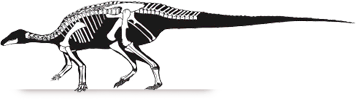
Pronunciation: yewt-O-don
Meaning: Ute tooth
Author/s: A. McDonald (2011)
Synonyms: None known
First Discovery: Utah, USA
Acta Ordinal: #773
Uteodon aphanoecetes
For over half a century the remains that would eventually become Uteodon were known as Camptosaurus medius (Marsh, 1894), having been assigned there by Gilmore in 1925.
They were wheeled out and lumped with the Camptosaurus name-bearing specimen Camptosaurus dispar (Galton and Powell, 1980) and then renamed Camptosaurus aphanoecetes (Carpenter and Wilson, 2008), but the big move came in 2011 when Andrew McDonald coined Uteodon during a long-overdiew overhaul of species previously assigned to Camptosaurus.
With its shorter neck vertebrae, straighter ischium (the topmost of the two lower, backwards-pointing ornithischian hip bones) which ended in a small "boot", and differences in the design of its lower jaw, braincase and shoulder blade, Uteodon isn't much like Camptosaurus at all. In fact, McDonald's analysis proved that Camptosaurus dispar is the only species of Camptosaurus that actually belongs to Camptosaurus, so he renamed Camptosaurus prestwichii (Lydekker, 1889) and Camptosaurus depressus (Gilmore, 1909) via a stint as Planicoxa depressa (Carpenter & Wilson, 2008) too; Cumnoria (the name originally chosen for this specimen by Hulke way back in 1880) and Osmakasaurus.
Uteodon belongs to Stryracosterna, a group of iguanodonts which includes the hadrosaurids and all dinosaurs more closely related to them than they are to Camptosaurus. Biomechanical study of its arms in 2008 convinced Carpenter and Wilson that Uteodon moved on all fours; its fingers and wrists only allowed limited movement so its "hands" weren't much use for anything other than walking on. In 2015, Carpenter decided that Uteodon wasn't Uteodon at all, and moved its braincase to Dryptosaurus and the rest of it back to his very own Camptosaurus aphanoecetes.
With its shorter neck vertebrae, straighter ischium (the topmost of the two lower, backwards-pointing ornithischian hip bones) which ended in a small "boot", and differences in the design of its lower jaw, braincase and shoulder blade, Uteodon isn't much like Camptosaurus at all. In fact, McDonald's analysis proved that Camptosaurus dispar is the only species of Camptosaurus that actually belongs to Camptosaurus, so he renamed Camptosaurus prestwichii (Lydekker, 1889) and Camptosaurus depressus (Gilmore, 1909) via a stint as Planicoxa depressa (Carpenter & Wilson, 2008) too; Cumnoria (the name originally chosen for this specimen by Hulke way back in 1880) and Osmakasaurus.
Uteodon belongs to Stryracosterna, a group of iguanodonts which includes the hadrosaurids and all dinosaurs more closely related to them than they are to Camptosaurus. Biomechanical study of its arms in 2008 convinced Carpenter and Wilson that Uteodon moved on all fours; its fingers and wrists only allowed limited movement so its "hands" weren't much use for anything other than walking on. In 2015, Carpenter decided that Uteodon wasn't Uteodon at all, and moved its braincase to Dryptosaurus and the rest of it back to his very own Camptosaurus aphanoecetes.
(Ute tooth, hidden in plain sight)Etymology
Uteodon is derived from "Ute" (pronounced “yewtâ€), the Native American peoples who inhabit northeastern
Utah in the vicinity of Dinosaur National Monument, and the Greek odon, "tooth".
The species epithet, aphanoecetes, is derived from the Greek "aphanoe-" (“hidden†and "-cetes" (“to dwellâ€), as in “hidden in plain sightâ€, in reference to the new species having been on exhibit for over 75 years before anyone realised it was unique.
Discovery
The remains of Uteodon were discovered at "Douglass Quarry" (named for Earl Douglass of the Carnegie Museum) in the Brushy Basin Member of the Morrison Formation, Dinosaur National Monument, Uintah County, Utah, USA. The holotype (CM 11337) is a virtually complete skeleton minus the skull.
 • Paul GS (2010) "


