







Pronunciation: oo-DAHN-o-SEH-ruh-tops
Meaning: Udan Sayr horn face
Author/s: Kurzanov (1992)
Synonyms: None known
First Discovery: Udan Sayr, Mongolia
Acta Ordinal: #378
Udanoceratops tschizhovi
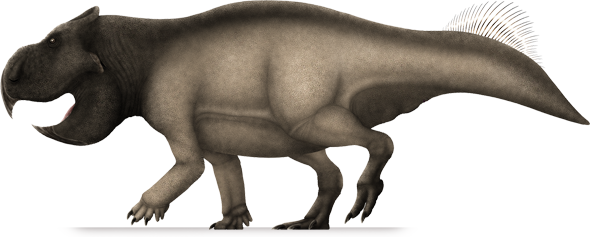
At an estimated four meters in length, Udanoceratops—Udan Sayr horned face—is the biggest non-ceratopsid neoceratopsian discovered thus far, and bearing in mind the only known adult remains amount to a skull and a far from complete skeleton, it could turn out to be bigger.
It is the first Asian representative of Leptoceratopsidae, a branch of ceratopsian ("horn faced") herbivores with a distinct lack of face horns and precious little in the way of a frill, though it did have an astoundingly deep and robust, curved lower jaw and parrot like-beak, probably for nipping needles and leaves from tough ferns, cycads and conifers.
With proportionately long hind legs, palaeontologists suspect Udanoceratops was bipedal, but some experts have mused that its deep "rudder-like" tail, formed by long spines on its vertebrae, may have been an adaptation for an aquatic lifestyle. You might think that those are brave assumptions, bearing in mind Udanoceratops is based entirely on a far from delicate 0.6 metre long skull. But they are extrapolated from the related Koreaceratops, Montanoceratops, Protoceratops and Bagaceratops, whose skeletons do preserve those features.
It is the first Asian representative of Leptoceratopsidae, a branch of ceratopsian ("horn faced") herbivores with a distinct lack of face horns and precious little in the way of a frill, though it did have an astoundingly deep and robust, curved lower jaw and parrot like-beak, probably for nipping needles and leaves from tough ferns, cycads and conifers.
With proportionately long hind legs, palaeontologists suspect Udanoceratops was bipedal, but some experts have mused that its deep "rudder-like" tail, formed by long spines on its vertebrae, may have been an adaptation for an aquatic lifestyle. You might think that those are brave assumptions, bearing in mind Udanoceratops is based entirely on a far from delicate 0.6 metre long skull. But they are extrapolated from the related Koreaceratops, Montanoceratops, Protoceratops and Bagaceratops, whose skeletons do preserve those features.
(Horned face from Udan Sayr)Etymology
Udanoceratops is derived from the Mongolian "Udan-Sayr" (the locality where it was found) and the Greek "keras" (horn) and "-ops" (face).The species epithet, tschizhovi, honors D.O. Tschizhov.
Discovery
The first fossils of Udanoceratops were discovered at "Udan-Sayr" in the Djadokhta Formation, Ömnögovi, Mongolia.
The holotype (PIN 3907/11) is an almost complete skull, 60 centimeters (24 in) long.


