DURIATITAN
a titanosauriform sauropod dinosaur from the Late Jurassic of England.
Pronunciation: doo-ree-uh-TY-tuhn
Meaning: Dorset giant
Author/s: Barrett, Benson and Upchurch (
2010)
Synonyms: See
below
First Discovery: Dorset, England
Acta Ordinal: #714
Duriatitan humerocristatus
(Dorset Giant with Crested Arms)Etymology
Duriatitan is derived from "duria" (the Latin name for Dorset) and the Greek "titan" (giant).
The
species epithet,
humerocristatus (hyoo-meh-roh-kris-TAY-tus), is derived from the Latin "humerus" (upper arm) and "crista" (crest), in reference to the
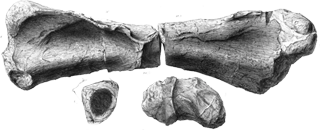
deltopectoral crest—a large muscle-attachment point—on the holotype upper arm bone.
ZooBank registry:
urn:lsid:zoobank.org:act:319E6F16-69C2-46F3-81B5-AEAF698D4253.
Ceteosaurus humero-cristatus (Hulke, 1874)
Cetiosaurus humerocristatus (Lyddeker, 1888)
Ornithopsis humerocristatus (Lyddeker, 1888)
Pelorosaurus humerocristatus (Lydekker, 1890).
Discovery
The remains of
Duriatitan were discovered in the lower member of the Kimmeridge Clay Formation near Sandsfoot, Weymouth, Dorset, England, by R.I. Smith.
The
holotype (BMNH 44635) is a partial left upper arm bone (humerus).
Estimations
Timeline:
Era: Mesozoic
Epoch: Late Jurassic
Stage: Kimmeridgian
Age range: 152-149 mya
Stats:
Est. max. length: 25 meters
Est. max. hip height: ?
Est. max. weight: 25 tons
Diet: Herbivore
Duriatitan
humerocristatus
References
• Hulke JW (1869) "Note on a large saurian humerus from the Kimmeridge Clay of the Dorset coast".
Quarterly Journal of the Geological Society, 25(1–2): 386–389. DOI: 10.1144/GSL.JGS.1869.025.01-02.66. [names Ischyrosaurus for another humerus from Dorset.]
• Hulke JW (1874) "
Note on a very large saurian limb-bone adapted for progression upon land, from the Kimmeridge clay of Weymouth, Dorset".
Quarterly Journal of the Geological Society of London, 30(1-4): 16-17. DOI: 10.1144/gsl.jgs.1874.030.01-04.17.
• Lydekker R (1888) "
Catalogue of the Fossil Reptilia and Amphibia in the British Museum (Natural History). Part I. Containing the Orders Ornithosauria, Crocodilia, Dinosauria, Squamata, Rhynchocephalia, and Proterosauria".
British Museum (Natural History), London: 1-309.
• Lydekker R (1890) "Catalogue of the Fossil Reptilia and Amphibia in the British Museum (Natural History).
Part IV. Supplement".
British Museum (Natural History), London: 1-295.
• Barrett PM, Benson RBJ and Upchurch P (2010) "Dinosaurs of Dorset: Part II, the sauropod dinosaurs (Saurischia, Sauropoda) with additional comments on the theropods".
Proceedings of the Dorset Natural History and Archaeological Society, 131: 113–126.
Time stands still for no man, and research is ongoing. If you spot an error, or want to expand, edit or add a dinosaur, please use
this form. Go
here to contribute to our FAQ.
All dinos are GM free, and no herbivores were eaten during site construction!
To cite this page:
Atkinson, L.
"
DURIATITAN :: from DinoChecker's dinosaur archive".
‹
http://www.dinochecker.com/dinosaurs/DURIATITAN›. Web access: 24th Oct 2026.