









Pronunciation: hip-o-DRAH-co
Meaning: Horse Dragon
Author/s: McDonald et al. (2010)
Synonyms: None known
First Discovery: Utah, USA
Acta Ordinal: #715
Hippodraco scutodens
Hippodraco was discovered in Utah's Cedar Mountain Formation at "Andrews site" around the same time as Iguanacolossus fortis was found at "Dons ridge". Unfortunately, a channel cutting through the area destroyed much of its right side, particularly the skull. But the left side was in pretty good nick, all things considered, which allowed palaeontologists to form a diagnosis. Thank the gods for symmetry.
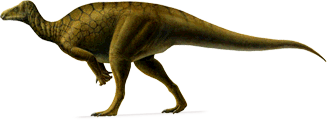
The "horse dragon" differs from its large and somewhat ponderous Utah bed-fellow Iguanacolossus in being rather small and lightly built by comparison. Like most Late Cretaceous non-hadrosaurid iguanodonts, it probably moved on two legs, browsed on all fours, and had a massive thumb claw as its only form of defence. It was lacking in the specialised features department and appears "primitive" compared to its closest same-age relatives from Europe and Asia.
Although reconstructed as a bit on the gracile side, large eye sockets suggest the holotype of Hippodraco may have been a juvenile, and visible sutures on its skull (fibrous joints between the bones that allow growth but which fuse with adulthood) indicate likewise. Workers found a stupendously large left shin and nine equally monstrous tail vertebrae (UMNH VP 20207) at the same site, but they can't be confirmed as an adult version of Hippodraco because it lacks those parts for comparison.
The "horse dragon" differs from its large and somewhat ponderous Utah bed-fellow Iguanacolossus in being rather small and lightly built by comparison. Like most Late Cretaceous non-hadrosaurid iguanodonts, it probably moved on two legs, browsed on all fours, and had a massive thumb claw as its only form of defence. It was lacking in the specialised features department and appears "primitive" compared to its closest same-age relatives from Europe and Asia.
Although reconstructed as a bit on the gracile side, large eye sockets suggest the holotype of Hippodraco may have been a juvenile, and visible sutures on its skull (fibrous joints between the bones that allow growth but which fuse with adulthood) indicate likewise. Workers found a stupendously large left shin and nine equally monstrous tail vertebrae (UMNH VP 20207) at the same site, but they can't be confirmed as an adult version of Hippodraco because it lacks those parts for comparison.
(Shield-Toothed Horse Dragon)Etymology
Hippodraco is derived from the Greek "hippos" (horse) and the Latin "Draco" (dragon) because of its long and low skull which resembles that of a horse.
The species epithet, scutodens, is derived from the Latin "scutum" (oblong shield) and "dens" (tooth), in reference to the shape of its lower jaw tooth crowns. ZooBank registry: urn:lsid:zoobank.org:act:D42E32C2-CFAE-479C-BCA1-C9EB576BC603.
Discovery
The remains of Hippodraco were discovered at "Andrew's Site" (named after discoverer Andrew R. C. Milner) near Arches National Park in the upper Yellow Cat Member of Utah's Cedar Mountain Formation.
The holotype (UMNH VP 20208) is the associated skeleton of a single individual, including a nearly complete skull.


