



Pronunciation: oh-RICK-toe-DROH-me-us
Meaning: Digging runner
Author/s: Varricchio et al. (2007)
Synonyms: None known
First Discovery: Montana, USA
Acta Ordinal: #640
Oryctodromeus cubicularis
Oryctodromeus is the first "confirmed" burrowing dinosaur of the Mesozoic. Scientists have discovered what they believe is an entrance tunnel with a couple of downwards turns to a central chamber in which an adult and two juveniles were discovered, and several tiny off-shoot tunnels which suggests the dwelling may have been shared with smaller burrowing animals for the sake of reciprocal back-scratching. Metaphorically.
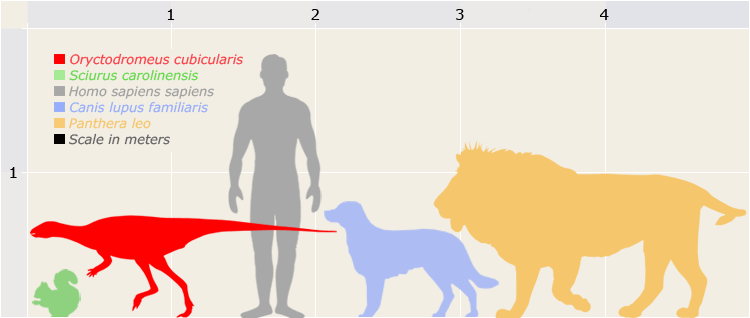
Compared to specialist burrowing critters such as moles, Oryctodromeus seems ill equipped for shoveling muck. It was lacking spade-like hands, and seems to have more in common with modern running animals that just happen to have the ability to shift dirt, such as rabbits or dogs, and its name, meaning "digging runner", seems to hit the nail on the head.
It is conceivable that burrowing dinosaurs could have survived the suspected meteor impact that brought about the K/Pg extinction and the following extreme temperatures and harsh conditions by seeking solace underground. Unfortunately, Oryctodromeus was long extinct by the end of the Cretaceous and missed the chance to demonstrate its potential survival technique by some thirty million years. Shame.
Compared to specialist burrowing critters such as moles, Oryctodromeus seems ill equipped for shoveling muck. It was lacking spade-like hands, and seems to have more in common with modern running animals that just happen to have the ability to shift dirt, such as rabbits or dogs, and its name, meaning "digging runner", seems to hit the nail on the head.
It is conceivable that burrowing dinosaurs could have survived the suspected meteor impact that brought about the K/Pg extinction and the following extreme temperatures and harsh conditions by seeking solace underground. Unfortunately, Oryctodromeus was long extinct by the end of the Cretaceous and missed the chance to demonstrate its potential survival technique by some thirty million years. Shame.
Digging runner of the lairEtymology
Oryctodromeus is derived from the Greek "orycto" (digging) and "dromeus" (runner).
The authors state the species epithet, cubicularis, means "of the lair" in Latin, but it's literal meaning is closer to "pertaining to the bedroom".
Discovery
The Digging runner was discovered in the Blackleaf Formation near the Lima Peaks, Beaverhead County, southwestern Montana.
The holotype (MOR 1636a) is the partial skeleton of an adult individual including: the premaxillae (upper beak), part of the braincase, three neck, six back, seven hip, and twenty three tail vertebrae, ribs, the shoulder girdle, an arm (minus the hand), both tibiae (shins), an incomplete fibula (calf) and a metatarsal (foot bone). The paratype (MOR 1636b) includes the skull and skeletal remains of 2 juveniles, 55% and 65% smaller than the holotype adult that they were found alongside.
Oryctodromeus remains have also been discovered in the Wayan Formation of southeastern Idaho.
Preparators
Carrie Ancell (Museum of the Rockies).