


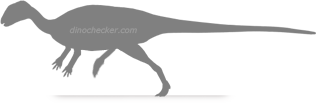
Pronunciation: OR-o-DROHM-uh-nay
Author: Brown, Evans, Ryan and Russell
Year: 2013
Meaning: Mountain runners (see etymology)
Locomotion: Bipedal (two legs)
Synonyms: None known
[Brown et al. 2013]Definition
All thescelosaurids more closely related to Orodromeus makelai than to
Thescelosaurus neglectus.
About
Orodrominae was the smaller, more specialised branch of Thescelosauridae, a lineage of nimble herbivores that flourished throughout much of the Cretaceous. Their ancestors emerged from early thescelosaurid stock before the rise of giant hadrosaurids and ceratopsians transformed many Late Cretaceous ecosystems. Fossils from North America dominate the record and suggest that orodromines remained comparatively conservative in body size while many other ornithischian groups experimented with gigantism. Their evolutionary strategy emphasized agility, behavioural flexibility, and subterranean refuge rather than increasing bulk.
Orodromines are best known for their compact bodies, powerful hindlimbs, and anatomical features consistent with digging and burrowing. Taxa such as Oryctodromeus preserve some of the strongest evidence for fossorial behaviour known among dinosaurs, including dozens of skeletons associated with fossil burrows. In some members of the group, a specialised articulation between the pubis and sacrum may have reinforced the pelvis, helping brace the body during digging. Like other thescelosaurids, they possessed relatively small skulls and simple chewing systems adapted for selective feeding on soft, easily processed plant material. Their small size and burrowing habits would have allowed them to exploit ecological opportunities unavailable to larger herbivores, and in doing so, forced palaeontologists to think differently about dinosaur behaviour and niche partitioning within Cretaceous ecosystems.
Click here to view Dinochecker's A-Z list of Orodromines.
Etymology
Orodrominae is derived from the Greek "oros" (mountain), in reference to the Egg Mountain site where Orodromeus—the group anchor—was found), "dromeus" (runner), because of the animal's presumed cursorial (running) habits, and "-inae" (sub family).Relationships
References
• Boyd CA, Brown CM, Scheetz RD and Clarke JA (2009) "Taxonomic revision of the basal neornithischian taxa Thescelosaurus and Bugenasaura". Journal of Vertebrate Paleontology, 29(3): 758–770. DOI: 10.1671/039.029.0328.
• Brown CM, Evans DC, Ryan MJ and Russell AP (2013) "New data on the diversity and abundance of small-bodied ornithopods (Dinosauria, Ornithischia) from the Belly River Group (Campanian) of Alberta". Journal of Vertebrate Paleontology, 33(3): 495-520. DOI: 10.1080/02724634.2013.746229.
• Madzia D, Boyd CA and Mazuch M (2018) "A basal ornithopod dinosaur from the Cenomanian of the Czech Republic". Journal of Systematic Palaeontology, 16(11): 967–979. DOI: 10.1080/14772019.2017.1371258.
• Holtz TR (2026) "Thescelosauridae and Ornithopoda: Beaks, bills and crests". GEOL 104: Dinosaurs — A Natural History. University of Maryland.


