




Pronunciation: THES-kel-o-SOR-us
Meaning: Wonderful lizard
Author/s: Gilmore (1913)
Synonyms: Bugenasaura (Galton, 1999)
First Discovery: Wyoming, USA
Acta Ordinal: #110
Thescelosaurus neglectus
Like goats and sheep, ornithopod dinosaurs weren't that bright, some of the smaller species spent much of their time hiding in burrows, and a specimen of Thescelosaurus called "Willow" that caused a media frenzy when scientists thought it contained a preserved heart, probably didn't. With that in mind, we couldn't help thinking of the dim Scarecrow, cowardly Lion and heartless Tin Man, and came up with a snappy "Wonderful lizard of Oz" lead-in for this page. Unfortunately, Thescelosaurus—meaning wonderful lizard—was a resident of South Dakota, Montana and Saskatchewan and had never been anywhere near Australia, not even on holiday. So that put the kibosh on that.
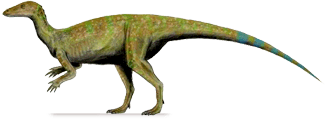
The thighs of Thescelosaurus were longer than their shins, so they weren’t built for speed. The hind limbs were robust, with four hoof-ended toes on each foot, and the animals were heavily built overall, with a broad rib cage and wide back. They may have browsed on all fours, given their relatively long arms and wide, five-fingered hands, and they were well equipped to handle all manner of low-lying fodder. Small pointed teeth (for piercing) and leaf-shaped teeth (for slicing) were housed in a long, low snout tipped with a narrow beak (for nipping). A combination of ridges on the upper and lower jaws, along with the inset position of the teeth, suggests the presence of muscular cheeks to aid in chewing or grinding. Because of their "heterodont dentition" (different kinds of teeth, for various tasks, in the same mouth), Thescelosaurus may have been omnivorous rather than strictly herbivorous, nibbling on whatever came their way. Humans are heterodonts too, with incisors, canines, premolars, and molars designed to deal with a wide range of foods.
Thescelosaurus were more robust than other early hypsilophodont-grade ornithopods and had shorter legs. But a lower centre of gravity, combined with a stiffened tail and an acute sense of balance, would have given them a distinct advantage during quick transitions and sharp turns, so they were likely elusive critters despite their relative bulk. Like most thescelosaurids, the skull of Thescelosaurus was fortified—in this case with long, rod-like palpebral bones above the eyes that formed unusually thick "eyebrows", but the reason for such reinforcement remains unknown.
The thighs of Thescelosaurus were longer than their shins, so they weren’t built for speed. The hind limbs were robust, with four hoof-ended toes on each foot, and the animals were heavily built overall, with a broad rib cage and wide back. They may have browsed on all fours, given their relatively long arms and wide, five-fingered hands, and they were well equipped to handle all manner of low-lying fodder. Small pointed teeth (for piercing) and leaf-shaped teeth (for slicing) were housed in a long, low snout tipped with a narrow beak (for nipping). A combination of ridges on the upper and lower jaws, along with the inset position of the teeth, suggests the presence of muscular cheeks to aid in chewing or grinding. Because of their "heterodont dentition" (different kinds of teeth, for various tasks, in the same mouth), Thescelosaurus may have been omnivorous rather than strictly herbivorous, nibbling on whatever came their way. Humans are heterodonts too, with incisors, canines, premolars, and molars designed to deal with a wide range of foods.
Thescelosaurus were more robust than other early hypsilophodont-grade ornithopods and had shorter legs. But a lower centre of gravity, combined with a stiffened tail and an acute sense of balance, would have given them a distinct advantage during quick transitions and sharp turns, so they were likely elusive critters despite their relative bulk. Like most thescelosaurids, the skull of Thescelosaurus was fortified—in this case with long, rod-like palpebral bones above the eyes that formed unusually thick "eyebrows", but the reason for such reinforcement remains unknown.
(Neglected Wonderful lizard)Etymology
Thescelosaurus is derived from the Greek "theskelos" (wonderful, surprising) and "sauros" (lizard), and the species epithet, neglectus, means "neglected" in Latin.
The story goes: after its 1891 discovery, Thescelosaurus was shipped back to the Smithsonian but the crate remained unopened and its contents were neglected for the next 22 years. What suprise Charles W. Gilmore felt when he opened the crate in 1913 and found the wonderful remains of a previously unknown saurian inside.
Discovery
The first Thescelosaurus fossils were discovered by John Bell Hatcher and William H. Utterback at Dogie Creek in the Lance Formation of Niobrara County, Wyoming, in July of 1891.The holotype (USNM 7757) is a skeleton, complete apart from the head and neck. More than four dozen specimens historically referred to Thescelosaurus neglectus have been recovered from the latest Cretaceous of western North America, primarily within the Hell Creek and Lance formations of the northern United States and the Frenchman Formation of Saskatchewan. These remains range from partial skeletons to isolated elements and represent a long history of collecting by museum and university field crews throughout the twentieth and twenty-first centuries. Although later revisions have reassigned some material to other species, the majority of well-preserved individuals continue to anchor the concept of Thescelosaurus neglectus as one of the best-represented small ornithischians of the terminal Cretaceous.


