









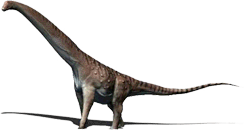
Pronunciation: men-DOE-suh-SOR-us
Meaning: Mendoza lizard
Author/s: González Riga (2003)
Synonyms: None known
First Discovery: Mendoza, Argentina
Acta Ordinal: #531
Mendozasaurus neguyelap
Upon discovery, Mendozasaurus ticked all the relevant boxes for South American titanosaurs, which isn't all good. Most Titan Lizards from this area are represented by the odd vertebra or six plus some supplementary limb fragments, and the remains that have anchored a couple of dozen species may conceivably pertain to only five or six. However, the huge Mendozasaurus sports some hugely unique features. But they're not as unique as they once were.
Apart from being the first dinosaur discovered in Mendoza Province, its cervical centra (main body of the neck vertebrae) were initially announced as proportionately shorter than all other titanosaurs barring India's Isisaurus, thus resulting in an unusually short neck, but that was likely due to compression during fossilisation. It does, however, have one of the thickest necks, thanks to robust neck ribs and massive fan-shaped neural spines that are twice as high and wider than the centrum to which they are attached. But so do eight other Argentinian titanosaurs that are now collectively known as Lognkosauria — the "Chief Lizards".
Mendozasaurus had an armoured back, fortified with 20cm oval armour plates, to protect it from the area's apex predator. Unfortunately, we don't know what that apex predator was because the Sierra Barrosa Formation has yet to yield a single large theropod bone, or the remains of any type of predator that have warrented a name, in fact. There are some fossilized bird footprints, though.
Apart from being the first dinosaur discovered in Mendoza Province, its cervical centra (main body of the neck vertebrae) were initially announced as proportionately shorter than all other titanosaurs barring India's Isisaurus, thus resulting in an unusually short neck, but that was likely due to compression during fossilisation. It does, however, have one of the thickest necks, thanks to robust neck ribs and massive fan-shaped neural spines that are twice as high and wider than the centrum to which they are attached. But so do eight other Argentinian titanosaurs that are now collectively known as Lognkosauria — the "Chief Lizards".
Mendozasaurus had an armoured back, fortified with 20cm oval armour plates, to protect it from the area's apex predator. Unfortunately, we don't know what that apex predator was because the Sierra Barrosa Formation has yet to yield a single large theropod bone, or the remains of any type of predator that have warrented a name, in fact. There are some fossilized bird footprints, though.
(First beast of Mendoza Province)Etymology
Mendozasaurus is derived from "Mendoza" (the province in which it was discovered) and the Greek "sauros" (lizard).
The species epithet, neguyelap,
is derived from two Millcayac words; "neguy" (first) and "yelap" (beast), so-named because
Mendozasaurus was the first dinosaur to be discovered in Mendoza Province.
Discovery
The remains of Mendozasaurus were discovered at Dry Creek (Arroyo Seco), Guillermo Hill (Cerro Guillermo), in the Sierra Barrosa Formation (previously thought to be the Plottier) of the Neuquén Group, Mendoza Province, Argentina. At a pitiful 900 meters tall, Cerro Guillermo is only the 3048th highest mountain in Argentina. In fact, it's only the 461st highest mountain in Mendoza!
The holotype (IANIGLA-PV 065/1-30) consists of 22 tail vertebrae, three chevrons and some chevron fragments.
Referred material that was associated with the holotype includes five neck vertebrae (IANIGLA-PV 076/1–3, 076/5, 084/1), two back vertebrae (IANIGLA-PV 76/4, 066), one rib (IANIGLA-PV 084/2), a right shoulder blade (IANIGLA-PV 068), a right sternal plate (IANIGLA-PV 067), a left and right humerus (IANIGLA-PV 069/1–2), a right radius (IANIGLA-PV 070/2), a right ulna (IANIGLA-PV 070/1), six metacarpals (IANIGLA-PV 071/1–5, 154), a fragment of pubis (IANIGLA-PV 072), half of a right thigh (IANIGLA-PV 073/1) and a left thigh (IANIGLA-PV 073/4), one left (IANIGLA-PV 074/2) and three right shins (IANIGLA-PV 073/2–3, 074/1), a left and right calf (IANIGLA-PV 074/3 and 074/4), a right ankle (IANIGLA-PV 155), 12 metatarsals (IANIGLA-PV 077/1–5, 100/1–6, 153), ten toe bones (IANIGLA-PV 077/6–12, 078/1–2, 079) and four armour plates (IANIGLA-PV 080/1–2, 81/1–2).
Based on two right shins identical in size, one right shin that is smaller and one left shin that is larger, the quarry contains a minimum of four individuals, but as few fossils were articulated, it's impossible to know which specimen owns what.


