









Pronunciation: RAT-iv-ATE-eez
Meaning: Foreteller of ratites
Author/s: McFeeters et al. (2016)
Synonyms: None known
First Discovery: Alberta, Canada
Acta Ordinal: #947
Rativates evadens
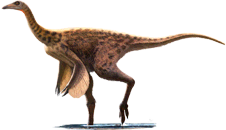
Rativates took the first meaningful step of its afterlife as Struthiomimus altus — an "ostrich mimic" which had long been a sub-genus of Ornithomimus: Struthiomimus (Ornithomimus) altus — having been formally assigned their by Dale Russell in 1972 based on the proportional similarity of its bones to other specimens of the same type, and perhaps the fact that its fossils had been listed simply as Struthiomimus by C.M. Sternberg on a 1950 map of Canadian dinosaur quarries. We were 16 years into the third millennium A.D. before these remains got their next meaningful outing, as Mcfeeters and colleagues counted Lags (lines of arrested growth) in a thin slice of thigh bone, much like the growth rings found in trees, and found that ROM 1790 was at least eight years old and almost fully grown at the time of death but only half the size of an adult version of Struthiomimus altus. Then they scrutinised the rest of its fossils, spotted features in the skull, tail, pelvis and feet that were lacking in the critter they had long been assigned to, and coined Rativates evadens: the "evasive foreteller of ratites".
(Evasive foreteller of ratites)Etymology
Rativates is derived from the Latin "ratis" (referring to the ratites: a group of large flightless birds that includes the modern ostrich) and "vates" (seer, foreteller, predictor of the future), alluding to the paradox of an ornithomimid (the theropod dinosaurs that are colloquially known as "ostrich mimics") existing before ostriches. The Latin "ratis", from which "ratite" is derived, literally means "raft" and refers to their flat sternum with no midline keel for wing muscle attachment.
The species epithet, evadens, means "to evade" in Latin, which refers to its ability to not only outrun predators in the Late Cretaceous but also avoid scientific scrutiny by hiding amongst the remains of Struthiomimus altus for over 80 years.
ZooBank registry: urn:lsid:zoobank.org:act:E023F82A-2F7D-4DF7-9F00-0DC7CC7E81E6.
Discovery
The remains of Rativates were discovered in the lower Dinosaur Park Formation at Quarry No. Q028, along the Red Deer River, near what is now Dinosaur Provincial Park, Alberta, Canada, by Levi Sternberg in 1934. The holotype (ROM 1790) includes a partial skull, a nearly complete pelvis, both hind limbs, foot bones, and part of a tail. Charles Mortram Sternberg (Levi's brother) listed the specimen as Struthiomimus on a map of dinosaur quarries published in 1950.


