




Pronunciation: SEG-no-SOR-us
Meaning: Slow lizard
Author/s: Perle (1979)
Synonyms: None known
First Discovery: Mongolia
Acta Ordinal: #277
Segnosaurus galbinensis
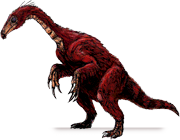
In 1979, palaeontologist Dr Altangerel Perle used the weirdly wide-hipped, stocky-limbed, long-hand-clawed Segnosaurus to anchor Segnosauridae and blazed a trail by assigning this group, albeit conditionally, to Theropoda (a branch of dinosaurs renowned for carnivory) but suspected they may have been fish-eaters, which many folks thought ludicrous. As it happens, they were theropods, they just weren't fish eaters. They weren't meat eaters either. And Perle wasn't blazing a trail at all.
A quarter century earlier, Evgeny Maleev had named Therizinosauridae to house Therizinosaurus, an equally weird critter from the Nemegt of Mongolia that he believed to be a giant turtle-like reptile. After further discoveries, Anatoly Rozhdestvensky determined that therizinosaurids were actually theropods, vegetarian theropods, no less, and in 1994 Jim Clark realised that Therizinosaurus was a "segnosaurid"#¹ but as its family was coined first it had priority, name-wise. All segnosaurids are now known as therizinosaurids.
A quarter century earlier, Evgeny Maleev had named Therizinosauridae to house Therizinosaurus, an equally weird critter from the Nemegt of Mongolia that he believed to be a giant turtle-like reptile. After further discoveries, Anatoly Rozhdestvensky determined that therizinosaurids were actually theropods, vegetarian theropods, no less, and in 1994 Jim Clark realised that Therizinosaurus was a "segnosaurid"#¹ but as its family was coined first it had priority, name-wise. All segnosaurids are now known as therizinosaurids.
(slow lizard from Galbin)Etymology
Segnosaurus is derived from the Latin "segnis" (slow or sluggish) and the Greek "sauros" (lizard), in reference to its stocky build.The species epithet, galbinensis, refers to Galbin (a region of the Gobi Desert where it was found).
Discovery
The first remains of Segnosaurus were discovered in the Bayan Shireh Formation at Amtgay (Amtgai), 70 km northeast of Khan-Bogdsomona, Galbin Govi, Mongolian People's Republic, by a joint Soviet-Mongolian paleontological expedition
in 1973. Further discoveries of the same critter were made in 1974-1975 both in the Amtgay and Khara-Khutul localities.
The holotype (IGM 100/80) is a partial skeleton consisting of a mandible (lower jaw), upper and lower arm bones, finger bones, a claw, pelvis, right thighbone, vertebrae from the hip and tail, and a rib. Paratypes IGM 100/81 (a lower leg), and IGM 100/82 and IGM 100/83 (two fragmentary skeletons also lacking the skulls), were discovered later.


