




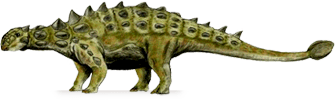
Pronunciation: SKOH-lo-SOR-us
Meaning: Spiny lizard
Author/s: Nopcsa (1928)
Synonyms: Oohkotokia? (Penkalski, 2013)
First Discovery: Alberta, Canada
Acta Ordinal: #156
Scolosaurus cutleri
Among the greatest mysteries in the history of Cretaceous dinosaur excavation is how William Edmund Cutler managed to find and extract an extraordinary ankylosaur that Franz Baron Nopcsa later named Scolosaurus cutleri in his honour, and how he escaped without losing his life.
Apparently, Cutler just happened to be strolling past an almost impossible-to-reach location halfway up a cliff when he stumbled upon Scolosaurus sticking feet first out of the rock. As he chiselled away the cliff face, the specimen crashed down on top of him, and he suffered serious upper-body injuries. Death was avoided, but he was none the wiser for it, and continued to ignore all sensible health and safety precautions right up until he fell to malaria in Tanzania whilst working for the British Museum of Natural History in 1925.
In 1971, Walter Coombes was convinced that only a single Campanian-aged Late Cretaceous ankylosaurid was present in North America and sunk Scolosaurus into Euoplocephalus tutus along with Anodontosaurus lambei and Dyoplosaurus acutosquameus, and that was accepted for many years. However, following the lead of Victoria Arbour, who reinstated Dyoplosaurus as a valid standalone critter in 2010 and suggested Anodontosaurus should be reinstated too, Paul Penkalski and William Blows officially rescued Scolosaurus from the pit in 2013 when they found it to be distinct from Euoplocephalus in the structure of its forelimb and form and details of its armour, and from Dyoplosaurus in features of its armour and design of its pelvis.
In 1971, Walter Coombes was convinced that only a single Campanian-aged Late Cretaceous ankylosaurid was present in North America and sunk Scolosaurus into Euoplocephalus tutus along with Anodontosaurus lambei and Dyoplosaurus acutosquameus, and that was accepted for many years. However, following the lead of Victoria Arbour, who reinstated Dyoplosaurus as a valid standalone critter in 2010 and suggested Anodontosaurus should be reinstated too, Paul Penkalski and William Blows officially rescued Scolosaurus from the pit in 2013 when they found it to be distinct from Euoplocephalus in the structure of its forelimb and form and details of its armour, and from Dyoplosaurus in features of its armour and design of its pelvis.
(William Cutler's Thorn Lizard)Etymology
Scolosaurus is derived from Greek "skolos" (thorn, spine or pointed stake) and the Greek "sauros" (lizard), named "to indicate the spiny nature of the creature".The species epithet, cutleri, honours discoverer William Cutler.
Discovery
The first remains of Scolosaurus cutleri were discovered in the Dinosaur Park Formation at Quarry 80 (aka "Sternberg Quarry 105") in Deadlodge Canyon, near Steveville, Alberta, Canada, by William Edmund Cutler in 1914.
The holotype (NHMUK R.5161) is nearly complete skeleton with in situ osteoderms and skin impressions, lacking a skull, the end half of a tail, and the right forelimb and hind limb.
A referred specimen from the same area (AMNH 5404) includes a skull with teeth, neck, back and tail vertebrae, ribs, shoulder girdle, an almost complete fore limb, parts of the pelvic girdle, a thigh, shin and calf, seven osteoderms, and several small unopened jackets.
In 2013, Arbour and Currie reassigned the holotype of Oohkotokia (MOR 433) to Scolosaurus cutleri, but that was reversed by Penkalski the following year.
Other species
Scolosaurus thronus — from the Latin "thronus" (elevated seat or throne), referring to "its high stratigraphic position within
the DPF and to the location of the quarry up on the face of
a butte" — (Penkalski, 2018).
Based on specimen ROM 1930 (a partial skeleton and skull) and CMN 842 (a halfring of neck armour previously referred to Euoplocephalus) found in the Dinosaur Park Formation at RTMP Quarry 41 (aka "Sternberg Quarry 112") near Happy Jack’s Ferry, Deadlodge Canyon, Alberta, by Charles H. Sternberg in 1914.
A halfring of neck armour (CMN 268) and several ribbed osteoderms (TMP 1998.53.1) were also referred here.


