









Pronunciation: kill-ESS-kuss
Meaning: Lizard (see below)
Author/s: Averianov et al. (2010)
Synonyms: None known
First Discovery: West Siberia, Russia
Acta Ordinal: #720
Kileskus aristotocus
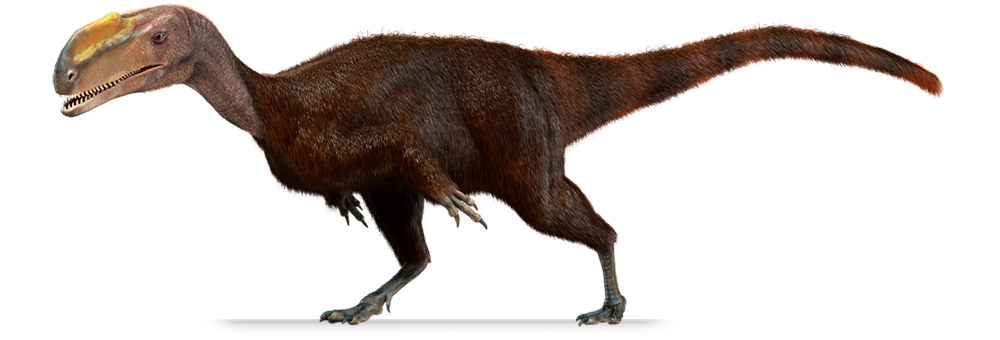
Kileskus remains aren't brilliant but they do bear a striking resemblance to both Guanlong and Proceratosaurus, so much so that the three were brought together in a branch of huge-nostrilled, possibly nose-crested tyrannosauroids called Proceratosauridae, which are some of the most ancient relatives of Tyrannosaurus.
Strangely, because Kileskus is missing the bit of skull that a crest may have been attached to it's far from certain that it actually had one.
Strangely, because Kileskus is missing the bit of skull that a crest may have been attached to it's far from certain that it actually had one.
(Noble Lizard)Etymology
In the language of Khakas as used by the Turkic peoples of the republic of Khakassia in southern Siberia, Kileskus means "lizard".The species epithet, aristotocus, is a Greek term denoting noble origin, which refers to its position amongst the derived theropods known as coelurosaurs, the lineage that includes "the Tyrant lizard king" (Tyrannosaurus rex).
Discovery
Kileskus was discovered in the Itat Formation at Berezovsk Coal Quarry, 2km south of Nikol'skoe Village, Sharypovo District, Krasnoyarsk Territory, West Siberia, Russia. The holotype (ZIN PH 5/117) is a right maxilla (tooth bearing bone of the upper jaw). More bits and bobs from the jaw, hands and feet, found in the same 2 m2 area, were also referred to Kileskus on the assumption that they belong to the same critter.
Two pieces of neck vertebra (ZIN PH 92/117 and ZIN PH 91/117), four tail vertebrae (ZIN PH 77/117, 95/117, 96/117, and 100/117), one chevron (ZIN PH 83/117), and a calfbone (ZIN PH 84/117) from the same quarry were referred to Kileskus in 2019.


