









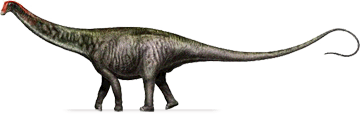
Pronunciation: BRON-toe-SOR-us
Meaning: Thunder lizard
Author/s: Marsh (1879)
Synonyms: See below
First Discovery: Wyoming, USA
Acta Ordinal: #56
Brontosaurus excelsus
In the late 19th century, amid the fossil-fueled frenzy of the Bone Wars, palaeontologist Othniel Charles Marsh named two massive sauropods: Apatosaurus ajax in 1877 and Brontosaurus excelsus in 1879. Both hailed from the Morrison Formation of the American West, and Marsh believed they represented distinct genera. However, in 1903, Elmer Riggs reexamined the material and concluded that Brontosaurus was not sufficiently different from Apatosaurus to warrant its own genus. Under the rules of taxonomic priority, Brontosaurus was demoted to a junior synonym, and for over a century, the name lingered only in popular imagination.
Yet, for decades reconstructed with an incorrect skull based on Camarasaurus, Brontosaurus refused to die. It thundered on in textbooks, museum halls, and the hearts and minds of dinosaur-loving children. The name—"thunder lizard"—was simply too evocative, too mythic to be buried by nomenclatural decree. And in 2015, a seismic shift occurred: a comprehensive phylogenetic analysis by Tschopp, Mateus, and Benson reexamined the diplodocid family tree with unprecedented granularity. Their study parsed dozens of specimens and hundreds of anatomical traits, and concluded that Brontosaurus excelsus was indeed distinct enough to merit its resurrection as a valid genus. Plus, it gained two more species, in B. parvus and B. yahnahpin.
This wasn’t mere nostalgia—it was cladistic rigour. The revived Brontosaurus differed from Apatosaurus in several key features: its neck vertebrae were more slender and less robust, its neural spines more gracefully tapering, and its overall build slightly more gracile. These differences, though subtle, were consistent across specimens, and at least as significant as those between other accepted genera. Still, the publication was not met with universal acceptance, as the mass media reaction was criticised as "superficial and premature". The battle over Brontosaurus was never confined to the scientific realm.
In 1989, the United States Postal Service released a stamp set celebrating "Dinosaurs". One stamp featured Brontosaurus, and scientists were apoplectic with rage, accusing the USPS of "fostering scientific illiteracy". The irony was thick: another stamp in the same set featured Pteranodon—a flying reptile that has never been a dinosaur, but that managed to dodge palaeontologist's ire. The controversy underscored a deeper tension: the public’s emotional attachment to iconic names versus the scientific community’s commitment to precision. To many, Brontosaurus was not just a misclassification—it was a beloved symbol of childhood wonder, and its erasure felt like a betrayal.
Yet, for decades reconstructed with an incorrect skull based on Camarasaurus, Brontosaurus refused to die. It thundered on in textbooks, museum halls, and the hearts and minds of dinosaur-loving children. The name—"thunder lizard"—was simply too evocative, too mythic to be buried by nomenclatural decree. And in 2015, a seismic shift occurred: a comprehensive phylogenetic analysis by Tschopp, Mateus, and Benson reexamined the diplodocid family tree with unprecedented granularity. Their study parsed dozens of specimens and hundreds of anatomical traits, and concluded that Brontosaurus excelsus was indeed distinct enough to merit its resurrection as a valid genus. Plus, it gained two more species, in B. parvus and B. yahnahpin.
This wasn’t mere nostalgia—it was cladistic rigour. The revived Brontosaurus differed from Apatosaurus in several key features: its neck vertebrae were more slender and less robust, its neural spines more gracefully tapering, and its overall build slightly more gracile. These differences, though subtle, were consistent across specimens, and at least as significant as those between other accepted genera. Still, the publication was not met with universal acceptance, as the mass media reaction was criticised as "superficial and premature". The battle over Brontosaurus was never confined to the scientific realm.
In 1989, the United States Postal Service released a stamp set celebrating "Dinosaurs". One stamp featured Brontosaurus, and scientists were apoplectic with rage, accusing the USPS of "fostering scientific illiteracy". The irony was thick: another stamp in the same set featured Pteranodon—a flying reptile that has never been a dinosaur, but that managed to dodge palaeontologist's ire. The controversy underscored a deeper tension: the public’s emotional attachment to iconic names versus the scientific community’s commitment to precision. To many, Brontosaurus was not just a misclassification—it was a beloved symbol of childhood wonder, and its erasure felt like a betrayal.
(Noble Thunder Lizard)Etymology
Brontosaurus is derived from the Greek "bronté" (thunder) and "sauros" (lizard).
The species epithet, excelsus, means "high, lofty, or noble" in Latin.
Synonyms of Brontosaurus excelsus:Brontosaurus amplus (Marsh, 1881), Apatosaurus excelsus (Riggs, 1903), Apatosaurus amplus (Riggs, 1903), Atlantosaurus excelsus (Steel, 1970), Atlantosaurus amplus (Steel, 1970). Synonyms of Brontosaurus parvus:
Elosaurus parvus (Peterson and Gilmore, 1902), Apatosaurus parvus (Upchurch et al., 2004). Synonyms of Brontosaurus yahnahpin:
Apatosaurus yahnahpin (Filla and Redman, 1994), Eobrontosaurus yahnahpin (Bakker, 1998).
Discovery
 The first remains of Brontosaurus were found in the Morrison Formation at Como Bluff, Wyoming, USA, by William Harlow Reed. The holotype (YPM 1980) is a fairly complete skeleton, lacking a skull.


