









Pronunciation: huh-SHEEN-lu-SOR-us
Meaning: He Xin-Lu's lizard
Author/s: Barrett (2005)
Synonyms: Yandusaurus multidens
First Discovery: Dashanpu, China
Acta Ordinal: #591
Hexinlusaurus multidens
One of the most confusing things, when digging back through dinosaur research, is the number of different names that certain critters have carried and the families to which they have been assigned. Unless you're an expert, it's hard to keep up! Hexinlusaurus, for example, was long thought to be a type of primitive ornithopod—specifically a hypsilophodontid—that He and Cai assigned to Yandusaurus as Yandusaurus multidens in 1983. But even then, some experts considered it to be a juvenile form of the name-bearer Yandusaurus hongheensis.
Scrutiny by Peng in 1992 led him to conclude that this specimen was a close relative of Agilisaurus, a genus he had already severed from the hypsilophodonts and reassigned to a group of primitive ornithischians known as fabrisaurids two years prior. In fact, he was convinced it was Agilisaurus, albeit a second species, which he named Agilisaurus multidens. After a stint as a possible species of the cerapod Othnielia, courtesy of Gregory Paul in 1996, it suffered the indignity of being informally referred to as "Proyandusaurus": a name lifted from a 1999 abstract by Fabien Knoll that should never have seen the light of day. Through all the chopping and changing, though, the species name multidens remained consistent, and it was still there when Paul Barrett and colleagues brought Hexinlusaurus multidens to its current resting place in 2005.
Hexinlusaurus was a small, bipedal, fleet-footed herbivore, and is now a recognised member of Neornithischia. Most of the still-valid dinosaurs to which Hexinlusaurus was previously linked are now all recognised neornithischians too, though none of them, nor Hexinlusaurus, belong to the clade's two main groups: Ornithopoda (iguanodonts and their relatives) or Marginocephalia (ceratopsians and pachycephalosaurs). By the by, "Fabrosauridae" and "Hypsilophodontidae" are no longer recognised families and have fallen out of use.
Scrutiny by Peng in 1992 led him to conclude that this specimen was a close relative of Agilisaurus, a genus he had already severed from the hypsilophodonts and reassigned to a group of primitive ornithischians known as fabrisaurids two years prior. In fact, he was convinced it was Agilisaurus, albeit a second species, which he named Agilisaurus multidens. After a stint as a possible species of the cerapod Othnielia, courtesy of Gregory Paul in 1996, it suffered the indignity of being informally referred to as "Proyandusaurus": a name lifted from a 1999 abstract by Fabien Knoll that should never have seen the light of day. Through all the chopping and changing, though, the species name multidens remained consistent, and it was still there when Paul Barrett and colleagues brought Hexinlusaurus multidens to its current resting place in 2005.
Hexinlusaurus was a small, bipedal, fleet-footed herbivore, and is now a recognised member of Neornithischia. Most of the still-valid dinosaurs to which Hexinlusaurus was previously linked are now all recognised neornithischians too, though none of them, nor Hexinlusaurus, belong to the clade's two main groups: Ornithopoda (iguanodonts and their relatives) or Marginocephalia (ceratopsians and pachycephalosaurs). By the by, "Fabrosauridae" and "Hypsilophodontidae" are no longer recognised families and have fallen out of use.
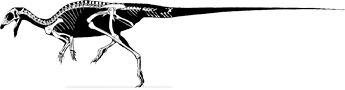
[He Xin-Lu's Lizard with Many Teeth]
Etymology
Hexinlusaurus is derived from "He Xin-Lu" (a professor at the Chengdu University of Technology and one of the two authors who originally named this specimen Yandusaurus multidens in 1983, in honour of his many contributions to the study of Middle Jurassic dinosaurs) and the Greek "sauros" (lizard).
The species epithet, multidens, is derived from the Latin "multus" (many) and "dens" (teeth), alluding to its many teeth. ZooBank registry: urn:lsid:zoobank.org:act:A4512092-0D6C-4C43-8E12-5301F5713839.
Discovery
The remains of Hexinlusaurus were recovered from the
Lower Shaximiao Formation in the famous Dashanpu Quarry, Sichuan Province, China, in 1981. Other dinosaurs known from Dashanpu include the club-tailed sauropod Shunosaurus, the problematic theropod Gasosaurus, and the small stegosaur Huayangosaurus.The holotype (ZDM T6001, housed at Zigong Dinosaur Museum) consists of an almost complete, articulated skull and associated skeletal material. A second skull and additional skeletal material (ZDM T6002) represent a paratype.
In 1984, He and Cai reported that the remains of at least ten individuals were recovered from the same quarry at Dashanpu. However, they weren't assigned specimen numbers and their whereabouts remain a mystery.
 [
[


